Explicit and Implicit Subsidies for Swiss Farmers

In the NZZHeidi Gmür discusses some of the many forms of government support for agricultural producers in Switzerland. She lists:

  • Direct payments: CHF 2.8 billion for 53’000 farms in 2016 (roughly CHF 50 thousand per farm).
  • Tariffs and other protectionist measures: According to the OECD, the value for farmers of these measures amounts to CHF 2 billion annually, while the value for the country is negative (CHF -0.5 billion).
  • Multiple tax breaks: Lower capital gains tax on land sales; no value added tax on sale of produce; lower tax on notional rental value; lower effective tax on gas consumption.

Commitment within Reach

In the FT, Richard Waters reports about the advent of the automated company.

The DAO — an acronym of decentralised autonomous organisation, the name given to such entities — has been set up to invest in other businesses, making it a form of investor-directed venture capital fund. … The organisation is governed by a set of so-called smart contracts which run on the Ethereum blockchain, a public ledger designed to make its operations transparent and enforceable.

In other words, the code provides a commitment mechanism. Imagine a world where government interventions can be encoded in a similar way. This could open the way for solving a central problem of democratic societies: The time inconsistency of optimal government plans.

FATCA in Reverse?

The Greens/EFA group in the European Parliament wants the European Union to exert more pressure on the United States: the US should no longer serve as a “tax haven” for European tax dodgers. Proposed measures include blacklisting and a FATCA-type 30% withholding tax on EU-sourced payments.

From the executive summary of the report commissioned by the group:

Two global transparency initiatives are underway that could help tackle financial crimes including tax evasion, money laundering and corruption: registration of beneficial ownership for companies (to identify the real persons owning or controlling such companies) and automatic exchange of bank account information between tax administrations. The European Union has made progress in both respects, with the adoption of a 4th anti-money laundering Directive (in May 2015) and by committing to implement the OECD’s common reporting standard for automatic exchange of financial account information. The United States (U.S.), in contrast, has done neither so far.

On May 5th, 2016 the U.S. announced new measures to improve its financial transparency, although not all the texts of the proposed regulations were provided. The U.S. Treasury announced three new measures: … In any case, not only would some of these new rules require Congress approval, but even the U.S. Treasury final proposals on beneficial ownership collection by financial institutions are not enough to solve all the problems nor to bring the U.S. into line with the OECD’s standard for automatic exchange of information. …

Two main issues in the U.S. affect the global progress towards transparency: … Company registration is regulated by each of the 50 states’ law. In 14 states, companies may be created identifying neither shareholders nor managers. At the federal level, tax rules require filing some information to obtain an Employer Identification Number (EIN). However, not all companies require an EIN and, even if they do, the ‘beneficial owners’ (the actual natural persons owning or controlling the company) are not necessarily among the information to be provided. Companies only have to identify one ‘responsible party’, who may be a nominee director. In order to (partially) address this, the White House 2017 budget proposal and the new measures proposed on May 5th, 2016 suggest requiring all companies (or according to the May 5th proposed rules, at least some foreign-owned disregarded entities, such as single-member limited liability companies) to obtain an EIN. Not only does this proposal need to become effective, but information would apparently still be about the ‘responsible party’ and not necessarily about the real physical person owning and controlling the company (the so-called beneficial owner).

… The U.S. has refused to join the trend for multilateral automatic exchange of information. Instead, it will implement its domestic law called the Foreign Account Tax Compliance Act (FATCA) and the related Inter-Governmental Agreements signed with other countries. However, these involve unequal exchanges of information: the U.S. receives more information than what it sends (for example, about beneficial ownership data). Oddly, though, the OECD did not include the U.S. among jurisdictions that did not commit to its new standard.

Even if the U.S. committed to exchange equal levels of information in the future, the current U.S. legal framework does not allow its financial institutions to collect beneficial ownership information for all relevant cases covered by the OECD’s global automatic exchange of information standard. U.S. financial institutions are currently only required to obtain information on beneficial owners for correspondent banking (i.e. accounts held for foreign financial institutions) and for private banking of non-U.S. clients (accounts holding more than USD 1 million).

Final rules to address these limitations have been announced on May 5th, 2016 although financial institutions must comply with them only by May 11th, 2018. However, the final rules still have the same problems that the IMF identified regarding the 2014 version of the rules so they will not fix all the problems. Remaining shortcomings include: some entities will still not be covered (i.e. insurance companies), the definition of ‘beneficial owner’ is incomplete (it does not include the ‘control through other means’ test, meaning that if you cannot identify at least one person owning 25% or more of the shares, financial institutions should try to find someone who controls the company through other means, before identifying only someone with a managerial position-who may be a nominee director), the verification of information would rely mainly on customer’s own certification, information on beneficial owners would be required for new accounts only (not for existing ones) and it will not need to be updated after the first time of collection, unless the financial institution becomes aware of changes as part of monitoring for risks. In addition, trusts will not be required to provide beneficial ownership information unless they own enough equity in an entity, such as a company, required to provide this information.

To fix this situation and promote equal levels of transparency, this paper provides a series of recommendations. For example, the European Union should consider including the U.S. in the upcoming list of tax havens, unless it effectively ensures registration of beneficial ownership information for companies and commits to equal levels of automatic exchange of information with European Union countries. Ideally, all financial centres should effectively implement the OECD standard for automatic exchange of information (by becoming a party to the OECD Amended Multilateral Tax Convention, signing the Multilateral Competent Authority Agreement and agreeing to exchange information with all other cosignatories). The European Union could thus consider imposing a sanction (such as a 30% withholding tax on all EU-sourced payments) against any financial institution that refuses to automatically exchange information about EU residents holding accounts abroad. In a second stage, sanctions could also be used to ensure that financial institutions from financial centres will also provide information to developing countries with which the European Union is already exchanging information.

Reports by René Höltschi in the NZZ as well as Markus Fruehauf und Winand von Petersdorff in the FAZ.

“Zinsen, Inflation und Realismus (Interest, Inflation and Realism),” FuW, 2016

Finanz und Wirtschaft, April 30, 2016. PDF. Ökonomenstimme, May 6, 2016. HTML.

The winners and losers of the current monetary environment are not that easy to identify. Investors holding long-term, non-indexed debt gain as unexpectedly low inflation shifts wealth from borrowers to lenders. Governments suffer from increased real debt burdens and reduced revenue due to effectively lower capital income tax rates. Policies that succeed in affecting the real exchange rate entail redistribution.

Neo-Fisherianism Turns Mainstream

On his blog, John Cochrane offers a stripped down model and some intuition for why inflation would rise after an increase in the interest rate. The model features the usual Euler (IS) equation and a Mickey Mouse Phillips curve—inflation is proportional to consumption (or output). The intuition:

During the time of high real interest rates — when the nominal rate has risen, but inflation has not yet caught up — consumption must grow faster [the Euler equation, DN]. … Since more consumption pushes up prices, giving more inflation, inflation must also rise during the period of high consumption growth.

Also:

I really like that the Phillips curve here is so completely old fashioned. This is Phillips’ Phillips curve, with a permanent inflation-output tradeoff. That fact shows squarely where the neo-Fisherian result comes from. The forward-looking intertemporal-substitution IS equation is the central ingredient.

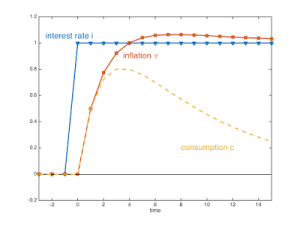
A slightly more plausible model with an accelerationist Phillips curve and very slowly adjusting adaptive expectations yields the following responses to an increase in the nominal interest rate:
cochr

John writes:

As you can see, we still have a completely positive response. Inflation ends up moving one for one with the rate change. Consumption booms and then slowly reverts to zero. …

The positive consumption response does not survive with more realistic or better grounded Phillips curves. With the standard forward looking new Keynesian Phillips curve inflation looks about the same, but output goes down throughout the episode: you get stagflation.

A November 2015 paper on the topic by James Bullard.

A critique by Mariana García-Schmidt and Michael Woodford in an NBER working paper. Abstract:

We illustrate a pitfall that can result from the common practice of assessing alternative monetary policies purely by considering the perfect foresight equilibria (PFE) consistent with the proposed rule. In a standard New Keynesian model, such analysis may seem to support the “Neo-Fisherian” proposition according to which low nominal interest rates can cause inflation to be lower. We propose instead an explicit cognitive process by which agents may form their expectations of future endogenous variables. Under some circumstances, a PFE can arise as a limiting case of our more general concept of reflective equilibrium, when the process of reflection is pursued sufficiently far. But we show that an announced intention to fix the nominal interest rate for a long enough period of time creates a situation in which reflective equilibrium need not resemble any PFE. In our view, this makes PFE predictions not plausible outcomes in the case of such policies. Our alternative approach implies that a commitment to keep interest rates low should raise inflation and output, though by less than some PFE analyses apply.

On his blog, Stephen Williamson addresses “Neo-Fisherian Denial.” Williamson starts with the model analyzed by Cochrane (see above) featuring a Mickey Mouse Phillips curve. He argues:

[This] NK model actually doesn’t conform to conventional central banking beliefs about how monetary policy works. What’s going on? … an increase in the current nominal interest rate will increase the real interest rate, everything else held constant. This implies that future consumption (output) must be higher than current consumption, for consumers to be happy with their consumption profile given the higher nominal interest rate. But, it turns out that this is achieved not through a reduction in current output and consumption, but through an increase in future output and consumption. This serves, through the Phillips curve mechanism, to increase future inflation relative to current inflation. Then, along the path to the new steady state, output and inflation increase.

Williamson recalls the “perils” of Taylor rules. And he addresses the critique by Garcia-Schmidt and Woodford:

Some people (e.g. Garcia-Schmidt and Woodford) have argued that Neo-Fisherian results go out the window in NK models under learning rules. As was shown above, these models are always fundamentally Fisherian in that any monetary policy rule has to somehow adhere to Fisherian logic on average – basically the long-run nominal interest rate is the inflation anchor. But there can also be learning rules that give very Fisherian results. …

Williamson also argues that other (non-Keynesian) monetary models give neo-Fisherian results as well.

A few years ago, also on his blog, Stephen Williamson argued that lowering the interest rate (by engaging in QE) might also affect the real interest rate:

… short-run liquidity effects are short-lived. Further, my work shows that there is another liquidity effect, associated with the interest bearing liquid assets, that causes the long run real rate to increase as a result of QE. … which implies lower inflation.

Further, there are other forces in play … The destruction of private sources of collateral and the shaky state of sovereign governments in parts of the world gave U.S. government debt a large liquidity premium – i.e. those things reduced real interest rates. As those effects go away over time, real rates of return will rise, shifting up the long-run Fisher relation, and reducing inflation if the Fed keeps the nominal interest rate at the zero lower bound.

In a paper, Peter Rupert and Roman Sustek dig deeper. In the abstract they write:

The monetary transmission mechanism in New-Keynesian models is put to scrutiny, focusing on the role of capital. We demonstrate that, contrary to a widely held view, the transmission mechanism does not operate through a real interest rate channel. Instead, as a first pass, inflation is determined by Fisherian principles, through current and expected future monetary policy shocks, while output is then pinned down by the New-Keynesian Phillips curve. The real rate largely only reflects consumption smoothing. In fact, declines in output and inflation are consistent with a decline, increase, or no change in the ex-ante real rate.

Addendum (May 11–12, 2016): In the abstract of their NBER working paper, Julio Garín, Robert Lester and Eric Sims write:

Increasing the inflation target in a textbook New Keynesian (NK) model may require increasing, rather than decreasing, the nominal interest rate in the short run. We refer to this positive short run co-movement between the nominal interest rate and inflation conditional on a nominal shock as Neo-Fisherianism. We show that the NK model is more likely to be Neo-Fisherian the more persistent is the change in the inflation target and the more flexible are prices. Neo-Fisherianism is driven by the forward-looking nature of the model. Modifications which make the framework less forward-looking make it less likely for the model to exhibit Neo-Fisherianism. As an example, we show that a modest and empirically realistic fraction of “rule of thumb” price-setters may altogether eliminate Neo-Fisherianism in the textbook model.

In his 2008 textbook, Jordi Gali discusses the role of the persistence of monetary policy shocks (page 51). If it is sufficiently persistent, a contractionary monetary policy shock raises the real rate (and lowers output) but decreases the nominal rate, due to the

decline in inflation and the output gap more than offsetting the direct effect [of the shock].

Condorcet vs Trump

In the New York Times, Eric Maskin and Amartya Sen explain Condorcet’s

system for electing candidates who truly command majority support. In this system, a voter has the opportunity to rank candidates.

Maskin and Sen’s fictitious example of the American primaries illustrates the difference between a plurality system (as used in the primaries) and a majority system a la Condorcet (where the winner is the one who defeats any other candidate in pairwise comparison). They also point out that

Kenneth Arrow’s famous “impossibility theorem” demonstrates that there is no perfect voting system, and majority rule is no exception. Specifically, as Condorcet himself noted, a majority winner might fail to exist … Such an outcome is quite unlikely in practice, but if it were to arise, a tiebreaking procedure would be needed.

IMFx

Last year, the IMF has joined the MOOC movement. On edX, the online education platform founded by Harvard University and MIT, the IMF contributes a set of “IMFx” courses developed by its Institute for Capacity Development. Courses cover

  • Debt sustainability analysis;
  • Energy subsidy reform; and soon
  • Financial programming and policies (analysis and program design) as well as
  • Macroeconomic forecasting.

Banks Without Debt

In his blog, John Cochrane points to SoFi, a FinTech company, as proof that banking services can be delivered by institutions without the traditional characteristics of a bank.

SoFi finances loans by selling equity. The loans are securitized and the cash is reinvested in loans. As John points out:

  • A “bank” (in the economic, not legal sense) can finance loans, raising money essentially all from equity and no conventional debt. And it can offer competitive borrowing rates — the supposedly too-high “cost of equity” is illusory.
  • There is no necessary link between the business of taking and servicing deposits and that of making loans. Banks need not (try to) “transform” maturity or risk.
  • To the extent that the bank wants to boost up the risk and return of its equity, it can do so by securitizing loans rather than by borrowing. (Securitized loans are not leverage — there is no promise of your money back when you want it. Investors bear any losses immediately and without recourse.)
  • Equity-financed banking can emerge without new regulations, or a big new Policy Initiative.  It’s enough to have relief from old regulations (“FDIC-free”).
  • Since it makes no fixed-value promises, this structure is essentially run free and can’t cause or contribute to a financial crisis.

Views on the Fiscal Theory of the Price Level

A conference at the University of Chicago’s Becker Friedman Institute addressed the status of the Fiscal Theory of the Price Level and the theory’s implications for current policy. Slides and papers are available on the conference website. Given that the conference was meant to resuscitate research on the FTPL and that the participants were selected accordingly, many contributions appear rather mainstream.

Chris Sims worries about indeterminacy of the price level if monetary policy is constrained by the ZLB and fiscal policy is passive.

Stephen Williamson argues that it is possible, in a simple model, to separate central bank determination of inflation and the price level from fiscal policy. As he writes on his blog:

The key thing here is that the central bank determines prices and inflation without any fiscal support. If the idea you got from the FTPL is that fiscal policy is necessary to determine the price level and inflation, that’s not correct. …

So, the conclusions are:

  1. FTPL forces us to think seriously about fiscal/monetary interaction, and that’s very important. But fiscal support is not necessary for monetary policy to work, nor is it useful to think of fiscal policy determining inflation on its own – the central bank can indeed be independent.
  2. Fiscal/monetary interaction becomes really important when we start thinking about the liquidity properties of government debt.
  3. Helicopter drops? Forget it. This is not some cure-all for a low-inflation problem.
  4. QE can be harmful, as it soaks up useful collateral and replaces it with inferior assets.
  5. Neo-Fisherian denial is not good for you. Central banks that want to increase inflation need to increase nominal interest rates.

John Cochrane argues that to get the cyclical properties of inflation “right” one should focus on the discount factor in the core FTPL equation, not the primary government surplus. The discount factor might also be affected by monetary policy. See also his blog post.

Harald Uhlig remains very skeptical and points to the lack of evidence favoring the FTPL. On his first slide, he asks:

  1. What does FTPL want to be?
    – A theory that can be consistent with the data? OK
    – An equation needed to complete a system? OK
    – A theoretical or extreme possibility? OK
    – A set of predictions, which occasionally work in exotic circumstances (“Brazil”)? PERHAPS
    – A set of predictions, which help often (“Taylor coeff < 1”)? ?
    – A useful framework for practitioners? ?
    – The miracle cure for the failures of other inflation theories? ?
    – A framework for the key interplay of fiscal and monetary policy? ?
  2. Where is the “smoking gun”? What set of facts “scream” FTPL? Specific predictions?
  3. Why is sovereign default off the table? Sure, a central bank can accommodate by inflating away debt … is that all?
  4. The US, Japan, the Eurozone have a near-deflation problem (is it?). Do you advocate “irresponsible” fiscal policies to solve this?
  5. What advice would you give the sunspot-branch of macro?

Taxing the Rich

In Taxing the Rich: A History of Fiscal Fairness in the United States and Europe, Kenneth Scheme and David Stasavage

explore the intellectual and political debates surrounding the taxation of the wealthy while also providing the most detailed examination to date of when taxes have been levied against the rich and when they haven’t. Fairness in debates about taxing the rich has depended on different views of what it means to treat people as equals and whether taxing the rich advances or undermines this norm. Scheve and Stasavage argue that governments don’t tax the rich just because inequality is high or rising—they do it when people believe that such taxes compensate for the state unfairly privileging the wealthy. Progressive taxation saw its heyday in the twentieth century, when compensatory arguments for taxing the rich focused on unequal sacrifice in mass warfare. Today, as technology gives rise to wars of more limited mobilization, such arguments are no longer persuasive. [Text from the Publisher’s website.]

Summary by Bryan Caplan:

Democracies have no inherent tendency to “soak the rich.”

Instead, democracies adopt high, progressive taxation in the face of compelling “compensatory” arguments for redistribution.

Only major wars of mass mobilization make compensatory arguments compelling.

Modern military technology has made majors wars of mass mobilization obsolete.

Therefore, tax the rich policies are a thing of the past, at least for developed countries.  They won’t be coming back

In Switzerland, New Bank Notes Render Old Notes Invalid

In the NZZ, Thomas Fuster reports about a consequence of the introduction of new banknotes in Switzerland: Old notes become invalid after a transition period of 20 years.

Nach der Emission des letzten Notenwerts einer neuen Serie kündigt die Schweizerische Nationalbank (SNB) jeweils den Rückruf der alten Serie an. Danach können die Banknoten zwar noch während zwanzig Jahren bei den Kassenstellen oder Agenturen der Nationalbank zum Nennwert umgetauscht werden. In der Folge sind die Noten aber wertlos – oder haben bestenfalls noch Sammlerwert. Eine solche Guillotine fällt das nächste Mal am 30. April 2020. Nach diesem Datum wird die Ende der 1970er Jahre ausgegebene sechste Banknotenserie, von der Ende vergangenen Jahres noch immer 1,14 Mrd. Fr. im Umlauf waren, ihren Geldwert verlieren.

Nevada Shell Companies, Elliott and Argentina—Some Unforeseen Consequences

In an earlier post (April 2015) I wrote:

The Economist reports about Nevada shell companies. In its eternal struggle against the Republic of Argentina, Elliott Management is inquiring about several shell companies in the state. They are suspected to own funds that might have been stolen from the Republic. The hedge fund reasons that it is entitled to those funds because they belong to Argentina, and Argentina owes 2 billion dollars to Elliott according to earlier court rulings. Elliott sued in Nevada for information on the shell companies and has been partially successful.

Now, The Economist reports about some unforeseen consequences of the earlier ruling and the “Panama Papers affair”:

Until now, getting information on clients of law firms in Panama has been [difficult]. … But sleuths may soon find it a lot easier, thanks to a court ruling in, of all places, Las Vegas.

In 2014 Elliott, a fund that owned debt on which Argentina had defaulted, sued in Nevada to compel Mossack’s local affiliate to provide information on shell companies, in the hope of discovering Argentine assets to seize. The affiliate, MF Nevada, claimed—implausibly—that it was independent of Mossack. …

A judge in Las Vegas ruled in March 2015 that Mossack and MF Nevada were one and the same. That put a crack in the wall of secrecy around American shell companies. But its full significance is only now becoming apparent: it means that, under an American law about assisting with foreign legal proceedings, any investigator anywhere in the world can subpoena Mossack, through the Nevada subsidiary, for information that could be relevant to cases in any country. …

Faced with the power of American subpoenas, Mossack’s head office will find it much harder to stonewall foreign requests for information. Ignoring them could mean being found in contempt of court. That would leave it open to penalties designed to compel it to comply, including asset seizures, in other countries where it operates.


Lego Fintech

In the FAZ, Tim Kanning reports about highly specialized Fintech companies increasingly forming cooperations to better cater to customer needs. Portals rely on services by specialist providers.

Brexit: Minor Costs, Unclear Benefits (Given the Political Constraints)

A report by Open Europe argues that for the UK the cost of Brexit would be minor. The benefits might be minor as well. For interest groups could make it hard to reap the potential benefits of newly gained flexibility.

… the path to prosperity outside the EU lies through: free trade and opening up to low cost competition, maintaining relatively high immigration (albeit with a different mix of skills), and pushing through deregulation and economic reforms in areas where the UK has historically been sub-par compared to international partners. … whether there is appetite for such changes in the UK is unclear.

… implications for the type of relationship the UK should seek with the EU post-Brexit. Realising the potential economic gains we’ve identified – notably via immigration and deregulation – means a relatively high degree of flexibility from the EU. The confines of a Norwegian or Swiss-style arrangement would not deliver this. As such, the best option would be for the UK to pursue a comprehensive bilateral free trade agreement, aimed at maintaining as much of the current market access as possible while also adopting a broader liberalisation agenda over the longer term.

Update: The Economist reports about other cost/benefit estimates.

Helicopter Drops of Money

In his blog, Ben Bernanke discusses the merits of “helicopter drops” as a monetary policy tool.

[A] “helicopter drop” of money is an expansionary fiscal policy—an increase in public spending or a tax cut—financed by a permanent increase in the money stock.

… the Fed credits the Treasury … in the Treasury’s “checking account” at the central bank, and those funds are used to pay for the new spending and the tax rebate.

… it should influence the economy through a number of channels, making it extremely likely to be effective—even if existing government debt is already high and/or interest rates are zero or negative. … the channels would include:

  1. the direct effects of the public works spending on GDP, jobs, and income;
  2. the increase in household income from the rebate, which should induce greater consumer spending;
  3. a temporary increase in expected inflation, the result of the increase in the money supply. Assuming that nominal interest rates are pinned near zero, higher expected inflation implies lower real interest rates, which in turn should incentivize capital investments and other spending; and
  4. the fact that, unlike debt-financed fiscal programs, a money-financed program does not increase future tax burdens.

[Debt financed spending programs lack channels 3 and 4.]

[Helicopter drops are subject to various] practical challenges of implementation, including integrating them into operational monetary frameworks and assuring appropriate governance and coordination between the legislature and the central bank.

Effort and Expertise, Not Ability

The Economist reviews a new book—“Peak”—by Anders Ericsson and Robert Pool:

Most notable is the “10,000 hour rule”: the idea that anyone can become an expert if they put in the time, a theme popularised by writers like Malcolm Gladwell.

At the heart of Mr Ericsson’s thesis is that there is no such thing as natural ability. Not for Mozart, nor for Garry Kasparov. Traits favourable to a task, such as perfect musical pitch, help at the outset but confer no advantage at higher levels. Rather, after a basic ability, it all comes down to effort.

Such mastery is possible because of what Mr Ericsson calls “deliberate practice”. This is focused training with an expert who can push an individual to a higher understanding of the craft. The key ingredient is mental representations: the ability to perform a task excellently without needing deliberate thought because similar situations have been so well practised that they seem second nature.

Inequality and the Welfare State

A new book on inequality by Branko Milanovic adopts an international perspective. The Economist reviews the book:

Like Mr Piketty, he begins with piles of data assembled over years of research. He sets the trends of different individual countries in a global context. Over the past 30 years the incomes of workers in the middle of the global income distribution—factory workers in China, say—have soared, as has pay for the richest 1% (see chart). At the same time, incomes of the working class in advanced economies have stagnated. This dynamic helped create a global middle class. It also caused global economic inequality to plateau, and perhaps even decline, for the first time since industrialisation began. …

Mr Milanovic suggests that both [Kuznets and Piketty] are mistaken. Across history, he reckons, inequality has tended to flow in cycles: Kuznets waves.

In the FT, Martin Wolf argues that a significant part of the (British) welfare state is about insurance rather than redistribution:

Evidence for this comes from another IFS study  … This examined the effects of the tax and benefit systems on people born between 1945 and 1954 …

First, income is far less unequal over lifetimes than in any given year. This is because a big proportion of inequality is temporary … Second, largely as a result, more than half of the redistribution achieved by taxes and benefits is over lifetimes rather than among different people. Third, in the course of adult life, only 7 per cent of individuals receive more in benefits than they pay in taxes, even though 36 per cent of people receive more in benefits than they pay in taxes in any given year. Finally, in-work benefits are just as good as out-of-work benefits at helping people who remain poor throughout their lives but they do less damage to incentives to work. Higher rates of income tax, meanwhile, target the “lifetime rich” relatively well because mobility at the top is relatively modest.

Marcel Fratzscher also wrote a book on the topic, focusing on Germany. He argues that the “Verteilungskampf” (redistributive struggle) intensifies and that equality of opportunity is being lost. In the FAZ, Jan Hauser summarizes a critique of the book by another Berlin based professor, Klaus Schroeder, who argues that the text is very short on substance.

Outcome Switching

The Economist reports about “outcome switching”—promoting empirical evidence collected in the context of a specific hypothesis test (that didn’t succeed) as support for a different hypothesis.

Outcome switching is a good example of the ways in which science can go wrong. This is a hot topic at the moment, with fields from psychology to cancer research going through a “replication crisis”, in which published results evaporate when people try to duplicate them.