Regulation Catches Up with Fintech

The Economist reports that regulation catches up with peer-to-peer lending:

Meanwhile, a case working its way through the courts may subject P2P loans to state usury laws, from which banks with a national charter are exempt. That would prevent the P2P firms from lending to the riskiest borrowers in much of America. In addition, the Consumer Financial Protection Bureau, a federal agency, announced this month that it would begin accepting complaints about P2P consumer lending.

Rates of delinquency are rising as well.

Blockchains in Banking (Commercial and Central)

The Economist reports about initiatives by commercial and central banks that aim at adopting the blockchain technology.

For commercial banks, distributed ledgers promise various advantages—but they also cause problems:

Instead of having to keep track of their assets in separate databases, as financial firms do now, they can share just one. Trades can be settled almost instantly, without the need for lots of intermediaries. As a result, less capital is tied up during a transaction, reducing risk. Such ledgers also make it easier to comply with anti-money-laundering and other regulations, since they provide a record of all past transactions (which is why regulators are so keen on them).

… Yet … [o]ne stumbling block is what geeks call “scalability”: today’s distributed ledgers cannot handle huge numbers of transactions. Another is confidentiality: encryption techniques that allow distributed ledgers to work while keeping trading patterns, say, private are only now being developed. … Such technical hurdles can be overcome only with a high degree of co-operation …

Meanwhile, central banks plan digital currencies built around the same technology.

Like bitcoin, these would be built around a database listing who owns what. Unlike bitcoin’s, though, these “distributed ledgers” would … be tightly controlled by the issuers of the currency.

The plans involve letting individuals and firms open accounts at the central bank …

Central banks … could save on printing costs if people held more bits and fewer banknotes. Digital currency would be tougher to forge, though a successful cyber-attack would be catastrophic. Digital central-bank money could even, in theory, replace cash. …

Better yet, whereas bundles of banknotes can be moved without trace, electronic payments cannot. … The technology first developed to free money from the grip of central bankers may soon be used to tighten their control.

Longer-Term Interest Rate Pegs

In his blog, Ben Bernanke discusses the merits of longer-term interest rate targeting as a monetary policy tool.

A lot would depend on the credibility of the Fed’s announcement. If investors do not believe that the Fed will be successful at pushing down the two-year rate … they will immediately sell their securities of two years’ maturity or less to the Fed. … the Fed could end up owning most or all of the eligible securities, with uncertain consequences for interest rates overall. On the other hand, if the Fed’s announcement is fully credible, the prices of eligible securities might move immediately to the targeted levels, and the Fed might achieve its objective without acquiring many securities at all.

… A policy of targeting longer-term rates is related to quantitative easing in that both involve buying potentially large quantities of securities. An important difference is that one sets a quantity and the other sets a price. … Concerns about “losing control of the balance sheet” were a factor behind the Fed’s choice of quantitative easing over rate targets while I was chairman.

Conceivably, QE and rate-pegging could be used together … with QE working through reduced risk premiums while the rate peg operates indirectly by affecting the expected path of short-term interest rates. … The principal limitations of rate pegs are similar to those of forward guidance: Both tools are relatively less effective at affecting interest rates at longer maturities, and even at shorter horizons both must be consistent with a credible or “time-consistent policy” path for short-term interest rates.

Exchange Rate Predictability

In a Study Center Gerzensee working paper, Pinar Yesin argues that the IMF’s Equilibrium Real Exchange Rate model (ERER) helps predict medium term exchange rate changes. The reduced form equation relates the real effective exchange rate to macroeconomic fundamentals.

… one of the models, namely the ERER model, outperforms not only the other two in predicting future exchange rate movements, but also the (average) IMF assessment. … the IMF assessments are better at predicting future exchange rate movements in advanced economies than in emerging market economies. Controlling for the exchange rate regime does not yield different results. … the IMF assessments have higher predictive performance in open economies than in closed economies. … safe haven currencies close the misalignment gap predicted by the models faster than other currencies.

… To assess exchange rates only a modified version of the ERER model is being used since 2012. The modified versions of the MB and ES models, while still being utilized, do not have a direct link to the exchange rate anymore. That is, the IMF ceased making a direct link from equilibrium current accounts to equilibrium exchange rates for now.

The German View of The Crisis

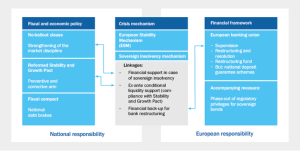
On VoxEU, representatives of the German Council of Economic Experts outline the German crisis narrative. In disagreement with the ‘consensus view’ outlined in Baldwin et al. (2015) the German economists including Lars Feld, Christoph Schmidt, Isabel Schnabel and Volker Wieland do not want to

implicate the ‘intra-Eurozone capital flows that emerged in the decade before the crisis’ as the ‘real culprits’. … [Rather] it is the government failures and the failures in regulation and supervision leading to those excessive developments that should take centre-stage in the Crisis narrative.

Consequently, their assessment of the policy response to the crisis is positive:

While the alleged consensus summary concludes that ‘the whole situation was made much worse by poor crisis management’, our view is that the ‘loans for reforms’ rationale underlying the rescue approach was not only sensible, since it was the only way to successfully address the underlying causes of the Crisis. It also worked and substantially improved matters.

Sensibly, the writers favor the

objective of retaining the unity of liability and control in all relevant fields of economic policy.

They promote the ‘Maastricht 2.0’ framework proposed earlier by the German Council.

wielandfig1

Habits

In his blog, John Cochrane discusses plausible features of habit models (that some other models share):

Consumption moves more with income in bad times.

In bad times, consumers start to pay inordinate attention to rare bad states of nature.

[The habit model] also gives a natural account of endogenous time-varying attention to rare events.

Spending Inequality

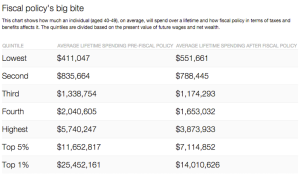
In a New Republic blog, Alan Auerbach and Larry Kotlikoff discuss lifetime spending inequality. Due to taxes and income variability over the life cycle, this is much smaller than wealth or income inequality.

3114c4f1245834a98303e801cbf1c9b8d304b13d

Auerbach and Kotlikoff write:

The top 1 percent of 40-49 year-olds face a net tax, on average, of 45 percent. … For the bottom 20 percent, the average net tax rate is negative 34.2 percent. …

Our standard means of judging whether a household is rich or poor is based on current income. But this classification can produce huge mistakes. … For example, only 68.2 percent of 40-49 year-olds who are actually in the third resource quintile using our data would be so classified based on current income.

fce80af444797972295d81da9d342c6ee1f61256

Stiff Competition for Brokerage Firms

The Economist reports about the “ostensibly free online services” provided by Robinhood, a share-trading app.

Instead of taking commissions from customers, Robinhood receives them from the trading venues to which it steers their orders, a controversial but common practice. It also earns returns from the cash clients leave in their accounts, and plans soon to offer margin trading—the buying of stock with borrowed money—for which it will charge a fee.

Earlier posts on fintech.

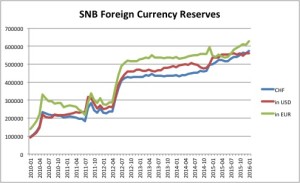
I Would Like to Withdraw A Couple Billion Swiss Francs: Legal Aspects

On his blog, Urs Birchler offers different perspectives on the question whether the Swiss National Bank (SNB) is obliged to pay out banks’ reserves in cash.

  • One view: Reserves are legal tender. The SNB therefore is not obliged to exchange reserves against cash.
  • Another view: According to the law, the SNB is required to provide sufficient cash. Moreover, reserves and cash were meant to be perfect substitutes.
  • Yet another view: Lawmakers would have written a different law had they known that the SNB considers it necessary to impose negative interest rates.

Ethereum

Ethereum

is a decentralized platform that runs smart contracts: applications that run exactly as programmed without any possibility of downtime, censorship, fraud or third party interference.

These apps run on a custom built blockchain, an enormously powerful shared global infrastructure that can move value around and represent the ownership of property. This enables developers to create markets, store registries of debts or promises, move funds in accordance with instructions given long in the past (like a will or a futures contract) and many other things that have not been invented yet, all without a middle man or counterparty risk.

Liquidity Trap Kills Liquidity Effect

In his blog, John Cochrane registers disagreement with Larry Summers and reiterates his own argument that in a liquidity trap, interest rate policy does not have a liquidity effect and thus, only a long-run “expected inflation” or “Fisher” effect:

When the liquidity effect is absent, the expected inflation effect is all that remains. Inflation must follow interest rates.

Caveat Emptor

The Economist reports about a US study on shady financial advisors. Over a ten year period, 7% of financial advisors were disciplined for misconduct. Typically, they took a pay cut and moved on to the next firm. A third became repeat offenders. BrokerCheck, run by the US Financial Industry Regulatory Authority, lets you check your local broker.

Mervyn King on Narrow Banking and Liquidity Insurance

In the FT, John Plender reviews Mervyn King’s “The End of Alchemy: Money, Banking and the Future of the Global Economy.” King diagnoses two problems underlying the crisis. First,

Interest rates today, he says, are too high to permit rapid growth of demand in the short run but too low to be consistent with a proper balance between spending and saving in the long run. The disequilibrium persists, as does a misallocation of capital to unproductive investments.

The second problem relates to the financial system and

the alchemy that runs through the financial system, whereby governments pretend that paper money can be turned into gold on demand and banks pretend that the short-term deposits used to finance long-term investments can be returned whenever depositors want their money back. …

King argues that Bagehot’s famous dictum on central bank crisis management — lend freely on good collateral at penalty rates — is out of date because bank balance sheets today are much larger and have fewer liquid assets than in the 19th century. Central banks are thus condemned in a crisis to take bad collateral in the shape of risky, illiquid assets on which they will lend only a proportion of the value, known as a haircut.

King suggests this lender of last resort role should be replaced by … a pawnbroker for all seasons. In effect, he offers an elegant refinement of the concept of “narrow banking”, which seeks to ensure that all deposits are covered by safe, liquid assets. In his system, banks would decide how much of their asset base to lodge in advance at the central bank to be available for use as collateral. For each asset, the central bank would calculate a haircut to decide how much to lend against it. Together with banks’ cash reserves at the central bank, this collateral would be required to exceed total deposits and short-term borrowings.

This central bankerly pawnbroking would facilitate the supply of liquidity, or emergency money, within a framework that eliminates the incentive for bank runs. It amounts to a form of insurance whereby the central bank can lend in a crisis on terms already agreed and paid for upfront …

The system would displace what King regards as a flawed risk-weighted capital regime ill-suited to addressing radical uncertainty. Today’s liquidity regulation would also become redundant. But banks would still need an equity buffer, with King seeing an equity base of 10 per cent of total assets as “a good start”, against the 3-5 per cent common today.

The current shortfall of fully liquid assets against deposits — the alchemical gap — could be eliminated progressively over 20 years, during which time the expectation would grow that banks would no longer be bailed out. The system would apply to all financial intermediaries …

Update: The Economist‘s reviewer writes:

… Lord King wants banks to buy “liquidity insurance”. In normal times banks would pledge collateral to the central bank, which would agree to lend a certain amount against it, if necessary. Banks would thus know in advance precisely how much help they could get in the event of a meltdown, making them behave responsibly when times were good.

Not Guilty of Money Laundering, but Out of Business Anyway

The Economist continues to report critically on US regulatory pressure abroad and possible double standards.

The Financial Crimes Enforcement Network (FinCEN), part of America’s Treasury, [has] rescinded a devastating finding against a European bank suspected of facilitating money-laundering. The withdrawal, less than a year after the designation, looks like a climbdown. …

Some suspect the bank was a pawn in a tussle between governments: miffed that Andorra was slow to adopt American-style anti-money-laundering rules … America decided to show who was boss by selecting a bank to pick on. There is some evidence to support this sacrificial-lamb theory. … an American diplomat suggested that America chose to “use the hammer” on BPA as a way of resolving wider concerns about Andorra. …

These cases highlight two problems with FinCEN’s money-laundering cudgel. The first is double-standards. It tends to go after only small banks in strategically unimportant countries … The second is its lack of openness. It faces no requirement to make detailed evidence public, or even available to a court, at the time of action. By the time any challenge is heard, it may be too late for the bank in question.

Argentina to Resolve Litigation and Return to International Capital Markets

In the FT, Daniel Politi and Pan Kwan Yuk report about an agreement between Argentina and four holdouts, yet to be implemented by Congress.

A few weeks ago, New York judge Griesa had indicated that he would lift the injunction preventing Argentina from servicing its restructured debt. This improved Argentina’s bargaining power. According to The Economist, Griesa had written: “President Macri’s election changed everything. … The Republic has shown a good-faith willingness to negotiate.”

Tax Treatment of Negative Interest Rates in Germany

The German Ministry of Finance has decided (p. 55, nr. 129a) that for tax purposes, negative interest rates are not to be treated as the opposite of positive interest rates. Instead they are considered fees. This treatment lowers taxable income to a lesser extent than would be the case under a symmetric treatment.

Swiss Government Dismisses Chicago Plan

The Federal Council dismisses the popular initiative to implement a Vollgeld regime—the “Swiss Chicago plan.” The Council argues that the proposal to abolish inside money creation runs counter to the government’s financial stability strategy and might undermine credit creation as well as trust in the Swiss Franc.

The Economist reports as well:

As the central bank issued more money, the government points out, its liabilities (cash) would rise without any increase in its assets. This, the government fears, would undermine confidence in the value of money. … There would need to be heavy-handed rules to make sure that banks did not create “money-like” instruments. … Finance, a huge part of the Swiss economy, would be turned inside-out, with unpredictable but probably expensive consequences. … The government also points out that the initiative only guards against one particular form of financial instability.