Category Archives: Contributions

“Frontiers of Digital Finance,” CEPR, 2025

CEPR eBook, 12 November 2025. PDF, HTML.

VoxEU column: Frontiers of Digital Finance: A Global Perspective. HTML.

VoxEU column: Frontiers of Digital Finance: Stablecoins, monetary ‘singleness’, tokenisation, and decentralised finance. HTML.
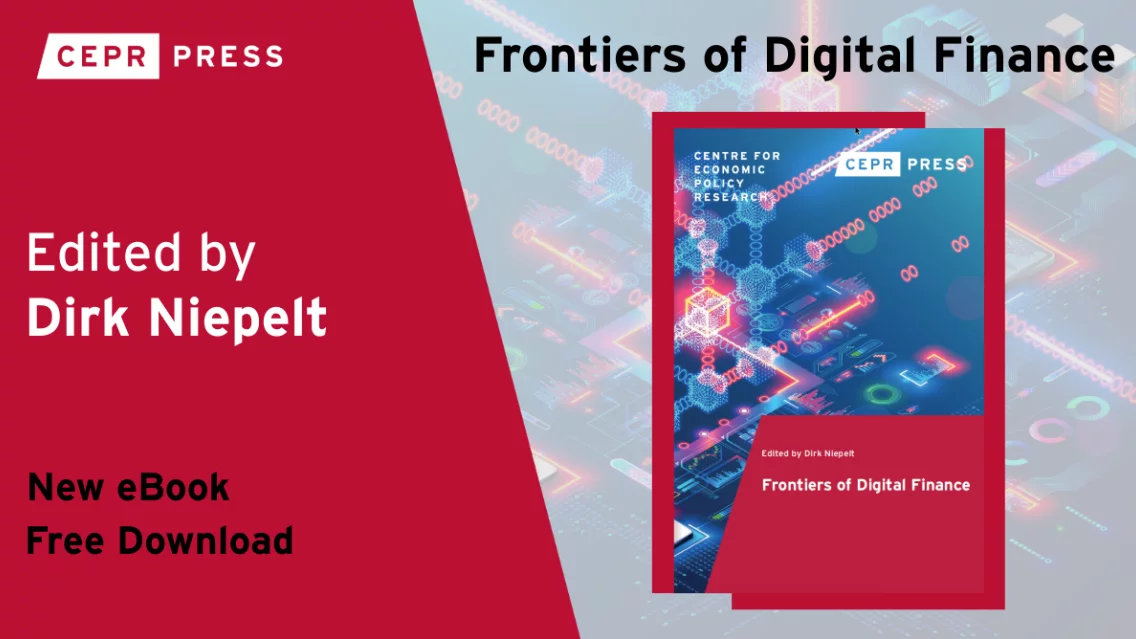
My introduction to/summary of the book:

The digitisation of payment, trading, and settlement systems is reshaping the financial architecture. New technologies are transforming how value is created, stored, transferred, and accounted for, altering the balance between public and private money, enabling the bundling of services, challenging traditional financial institutions, and prompting a wave of regulatory and institutional responses.

The global picture is uneven. Some regions are leapfrogging others, and conflicting ideologies about the proper role of the state in money give rise to fragmentation and concerns about monetary sovereignty.

This book offers an overview of major trends, as analysed by leading researchers and policymakers. It is structured in four parts. Part 1 presents regional perspectives, examining the approaches taken by India, Brazil, sub-Saharan Africa, the United States, and the euro area. For the euro area, the focus is on the digital euro and its implications for monetary sovereignty, privacy, and holding limits aimed at preserving financial stability.

Part 2 delves into stablecoins – the shooting stars in the digital financial ecosystem. Their evolution has spurred a flurry of policy debate, with the European Union’s Markets in Crypto-Assets Regulation (MiCAR) and the US GENIUS Act now offering greater regulatory clarity.

Part 3 turns to the concept of monetary ‘singleness’ – the principle that all forms of money in a currency area should be fully interchangeable and trade at par. As new digital forms of money proliferate, the cohesion of the monetary system may be called into question.

Part 4 brings together chapters on tokenisation, digital platforms, and decentralised finance (DeFi), and their broader impact on service bundling, credit allocation, financial inclusion, and consumer protection.

Regional perspectives

In the opening chapter of Part 1, Amiyatosh Purnanandam describes how India’s Unified Payments Interface (UPI), launched in 2016, has improved the efficiency of account-based payment systems by addressing the core frictions of information exchange, authentication, and final settlement. Developed under a public-private partnership, UPI enables real-time, low-cost, and interoperable digital payments between any two entities, regardless of their bank or payment service provider. India overcame challenges around identity verification and financial inclusion by implementing a nationwide system of digital, biometric-based identification and by expanding access to bank accounts for large segments of the unbanked population. These developments, alongside digital infrastructure investments and regulatory support for private sector participation, allowed UPI to lower transaction costs and provide small businesses with digital transaction histories that improved access to credit.

Purnanandam highlights how demonetisation and the COVID-19 pandemic accelerated the adoption of UPI. The system’s interoperable design allows users to choose among competing apps, reinforcing network effects and encouraging innovation. Early adoption by banks in some areas led to persistent increases in digital payment usage. Moreover, UPI has enabled streamlined welfare disbursements, with nearly 60% of subsidy payments being delivered directly into beneficiary accounts by 2024. According to Purnanandam, the UPI experience demonstrates the critical role of coordinated efforts across public and private sectors, along with a flexible and inclusive regulatory framework.

Fabio Araujo and Arnildo da Silva Correa describe the Central Bank of Brazil’s comprehensive innovation strategy, Agenda BC#, fostering tokenisation and integration to enable faster, more transparent, and programmable asset transfers. The agenda is built around four interlinked pillars: (1) Pix, an instant payment system launched in 2020, which also supports a ‘synthetic’ retail central bank digital currency (CBDC) model; (2) Open Finance, which promotes secure data sharing and competition; (3) Drex, Brazil’s central bank digital currency designed as a platform for a tokenised economy; and (4) the internationalisation of the Brazilian real, through regulatory modernisation and cross-border interoperability. Each component reinforces the others, creating a cohesive, digital financial ecosystem that enhances efficiency, security, innovation, and inclusivity.

Pix marked the foundational shift, offering a public infrastructure for instant, programmable payments that has been widely adopted across Brazil and credited with improving financial inclusion and spurring innovation. Open Finance expanded the ecosystem by allowing consumers to share financial data among institutions, unlocking more tailored services and competitive offerings. Drex builds on this by introducing distributed ledger technology, enabling advanced programmability, atomicity, and secure, tokenised deposits while incorporating privacy safeguards such as zero-knowledge proofs. Finally, internationalisation efforts are aligning domestic systems with global standards. Together, these initiatives aim to create a user-centric financial system where services are accessed through intelligent aggregators, enhanced by AI and driven by user-controlled data.

Luca Ricci and co-authors describe how digital innovations are reshaping the payment landscape across sub-Saharan Africa, facilitating financial inclusion, payment efficiency, lower remittance costs, and reduced informality. Private mobile money has been particularly impactful, with account ownership far outstripping the growth of traditional bank accounts. While central bank digital currencies, fast payment systems, and crypto assets are debated (with Nigeria having already launched the eNaira), their broader adoption is held back by weak digital infrastructure, limited institutional capacity, low levels of financial and digital literacy, and the high costs of system deployment. Cross-border payments remain slow and costly, and fragile governance frameworks heighten concerns about consumer protection, data privacy, and financial integrity.

To address these challenges, the authors outline four policy priorities: (1) investment in infrastructure and skills; (2) supporting private innovation within secure and competitive regulatory frameworks that enable interoperability and reinforce governance; (3) positioning public digital tools to complement – rather than compete with – private solutions, based on assessments of market gaps and resource needs; and (4) fostering regional and international coordination to ensure interoperability and resilience. Ultimately, digital payment reforms must be anchored in sound macroeconomic policies that preserve monetary sovereignty and financial stability.

Michael Lee argues that the 2025 Executive Order on digital financial technology and the GENIUS Act represent a strategic shift in the United States towards private sector-driven innovation in blockchain-based financial systems. The Executive Order rules out the development of a CBDC while endorsing a technology-neutral approach and regulatory clarity for stablecoins. The GENIUS Act establishes a federal framework for fiat-backed payment stablecoins, mandating at-par redemption, backing primarily by US dollar cash and cash equivalents, and regulatory oversight. Regarding the more than 340 stablecoins in circulation – 97% dollar-denominated and dominated by Tether and Circle – concerns remain over reserve transparency, and redemption practices vary widely.

Beyond stablecoins, Lee describes the increasing tokenisation of Treasury funds and commercial bank deposits. Tokenised US Treasury funds are largely held by long-term investors or used as on-chain reserves. Deposit tokens and tokenised deposits typically align with existing regulatory standards – including full know-your-customer (KYC)/anti-money laundering (AML) compliance and access via whitelisting – and can pay interest. In contrast, stablecoins circulate more freely (issuers functionally manage a whitelist only at the issuance stage) but are barred from offering interest directly under the GENIUS Act; however, issuers often partner with platforms to indirectly deliver yield. Together, these instruments form a spectrum, each balancing accessibility and return in different ways.

Ulrich Bindseil and Piero Cipollone argue that central bank electronic cash (CBEC) is essential to preserving monetary sovereignty, as private (often foreign) service providers increasingly dominate retail payments. This carries significant risks: rising payment costs due to oligopolistic market power, reduced financial and monetary stability, loss of seignorage income, and increased vulnerability to geopolitical risks. Bindseil and Cipollone present CBEC not as a disruption but as a necessary evolution to ensure the continued public provision of a neutral, secure, and sovereign monetary instrument that is designed to complement rather than replace commercial bank money.

The authors emphasise that monetary sovereignty faces new threats from globalisation, the advent of new technologies such as public blockchains, and a surge of nationalism that dismisses the merits of international co-operation. CBEC helps counter these threats across five dimensions: it protects macro-financial stability by preventing dollarisation; it ensures access to payment systems without abuse of market power; it preserves seigniorage income and the financial independence of central banks; it reduces strategic dependencies on foreign actors; and it protects informational sovereignty by avoiding overreliance on foreign-owned platforms.

Maarten van Oordt argues that the accelerating shift away from cash in the euro area is driving a significant erosion of privacy in payments. Unlike cash, electronic payments generate detailed records that are monitored by payment service providers and subjected to regulatory oversight. These data are not only used for compliance but also for commercial purposes, and they can be leveraged not just to monitor but also to censor or exclude individuals. The author emphasises that common justifications for payment surveillance – such as crime prevention and tax enforcement – do not automatically warrant broad monitoring powers in a democratic society.

Van Oordt does not expect the currently proposed digital euro design, which includes both online and offline payment options, to close the growing ‘privacy gap’ in retail payments. Online digital euro payments would be processed centrally, offering little improvement over existing systems, and, depending on the robustness of pseudonymisation techniques, could even exacerbate privacy risks. Offline payments, while potentially more private, face challenges such as usage limits and unresolved security concerns. Without critical amendments – such as enabling remote payments through offline balances or designing online payments to emulate the anonymity of cash – the author foresees the digital euro as heightening surveillance risks. He stresses that privacy in payments is a public good and warns that failing to safeguard it in the digital age would squander a crucial opportunity to redesign the financial system in such a way that upholds individual autonomy and democratic values.

Katrin Assenmacher and Oscar Soons explain that the European Commission’s June 2023 legislative proposal tasks the European Central Bank (ECB) with developing instruments to limit the use of the digital euro as a store of value, including the introduction of individual holding limits. These limits are intended to balance three objectives: enabling convenient payments; ensuring smooth monetary policy transmission; and safeguarding financial stability. The authors describe the ECB’s methodology for calibrating these limits so they are high enough for payment use but low enough to prevent significant bank deposit outflows that could destabilise funding structures.

To assess the appropriate holding limits, the ECB considers both a business-as-usual scenario – where the digital euro is mainly used for payments – and a flight-to-safety scenario, which involves mass withdrawals from banks during crises. Surveys and econometric analyses yield a broad range of estimates for digital euro demand. However, even under conservative assumptions, research indicates that large deposit outflows would likely only arise if individual holding limits exceeded €5,000, at which point banks would need to rely more heavily on central bank or market-based funding to manage liquidity pressures.

Stablecoins

In the first chapter of Part 2, Hugo van Buggenum, Hans Gersbach, and Sebastian Zelzner discuss how stablecoins – digital assets pegged to fiat currencies – have rapidly evolved from niche instruments into a major segment of digital finance. While fiat-backed stablecoins promise to combine the technological advantages of crypto with the stability of traditional money, depegging episodes underscore their vulnerability to run risks due to illiquid reserves, limited issuer commitment, and noisy market signals. Trading on active secondary markets can mitigate run incentives by giving holders alternative exit options when redemptions are restricted.

The authors discuss how the EU MiCA Regulation and the US GENIUS Act address systemic risks posed by stablecoins, focusing on reserve quality, redemption rights, and transparency. They suggest that well-designed redemption restrictions – such as gates or fees – should be permitted to prevent destabilising runs. They also caution against the remuneration of stablecoins, as interest payments could trigger destabilising competitive dynamics and coordination failures across issuers, and examine potential effects on banks, monetary policy transmission, and overall financial stability.

Rodney Garratt highlights the dramatic growth of the US dollar-denominated stablecoin market and the fundamental regulatory shift that now encourages institutional participation, including by commercial banks. The author expects the entry of traditional financial institutions to reshape the competitive landscape, with banks serving their regulated clients via public blockchain-based payment rails, while existing issuers continue to operate within the crypto ecosystem.

Garratt likens stablecoins to digital travellers’ cheques – clearing instruments redeemable at par but not tied to individual account holders. As banks enter the space, redemption frictions and interoperability challenges echo historical issues from the pre-clearinghouse era of cheque processing. He argues that a universal stablecoin clearing system will be crucial for broader adoption, ensuring fungibility and monetary singleness across issuers. While stablecoins may not offer clear advantages in many domestic use cases – given the rise of real-time payment systems – he sees potential in global, programmable transactions, particularly for corporate users needing low-cost, high-speed, cross-border payments. Garratt predicts bank-issued stablecoins will have short lifecycles, acting as temporary payment instruments rather than long-term stores of value.

Steve Cecchetti and Kermit Schoenholtz compare stablecoins and tokenised deposits within the context of the new US regulatory framework. They note that although the GENIUS Act prohibits interest payments to holders, limits eligible reserve assets, and enforces compliance with KYC, AML, and anti-terrorist financing (ATF) standards, it still contains significant regulatory gaps. Platforms can circumvent the interest ban by offering yield-like ‘rewards’; reserve requirements permit exposure to run-prone assets like prime money market funds and uninsured bank deposits; and enforcing illicit-use restrictions is particularly challenging for users of noncustodial wallets. Most notably, the absence of capital requirements raises doubts about the ability of stablecoins to serve as safe, information-insensitive assets under stress.

According to the authors, tokenised bank deposits offer a more stable and robust alternative, combining the legal protections of traditional bank deposits with features such as programmable settlement, real-time clearing, and blockchain interoperability. Because they are issued by regulated, FDIC-insured banks with central bank access, tokenised deposits are shielded from many of the structural vulnerabilities that afflict stablecoins. Moreover, they offer stronger privacy protections, reduce cross-border redemption risks, and more easily support multiple currencies – mitigating concerns around dollar dominance.

David Andolfatto explores the role of Tether (USDT) in the evolving landscape of private digital money, highlighting both its utility and its vulnerabilities. Pegged to the US dollar while operating outside the traditional banking system, Tether fills critical roles in blockchain-based asset trading, cross-border payments, and as a dollar substitute in emerging markets. While verified institutional users are entitled to par redemption, retail users depend on secondary market liquidity. This two-tier structure and the absence of regulatory oversight raise financial stability concerns.

Despite claims of full reserve backing, primarily in short-term US Treasuries, Tether’s transparency is limited to attestations, and it is legally structured to avoid US regulation. But Andolfatto argues that Tether’s reliance on Cantor Fitzgerald, a US-regulated primary dealer, presents a policy window for oversight and systemic risk mitigation. In particular, US policymakers could require Cantor to act as a fiduciary, using its Federal Reserve master account to tighten reserve management, and applying existing AML/KYC standards.

Richard Portes argues that the multi-issuer stablecoin model (MISC), where a stablecoin is issued jointly by EU-regulated institutions and third-country entities, presents serious financial stability risks and regulatory challenges. This arrangement, not explicitly foreseen under the MiCA regulation, creates loopholes for regulatory arbitrage, fragmented reserve management, and accountability confusion, particularly during redemption runs or crises. The fungibility of tokens across jurisdictions allows issuers and holders to treat them as interchangeable, even though only part of the system is subject to EU rules, reserves may be ringfenced abroad during stress, and redemptions could be unequally honoured.

Portes sees several policy options, including banning MISCs outright, amending MiCA to explicitly regulate cross-jurisdiction co-issuance, or developing global regulatory standards. He notes that some EU policymakers have voiced strong opposition to MISCs, and warns that regardless of the legislative path chosen, urgent supervisory and legal adaptations are needed to preserve financial stability, close regulatory gaps, and uphold MiCA’s credibility in a globalised crypto-financial system.

Harald Uhlig compares European plans for a CBDC and the US strategy to promote privately issued stablecoins. While the ECB sees CBDC as a way to modernise cash, preserve monetary sovereignty, and reduce dependence on foreign payment providers, the US approach possibly reflects stronger trust in markets and concerns about government overreach and privacy. Despite these different strategies, the author notes a fundamental convergence: both digital currencies must avoid paying interest and may ultimately rely on central bank backing to ensure safety and stability.

Uhlig is critical of the US regulatory framework that prevents stablecoins from becoming robust and competitive – particularly the denial of Federal Reserve master accounts and interest payments, which would allow them to operate like fully reserved narrow banks. He warns that this creates stablecoins that are ‘fragile by design’, as illustrated by recent depegging events. He also highlights the inconsistency of paying interest on bank reserves but not on digital cash held by the public, viewing it as a concession to the traditional banking sector. While stablecoins may offer innovative features like smart contracts and programmable payments, their growth could generate international tensions. Ultimately, Uhlig sees stablecoins and CBDCs as part of ongoing creative destruction in finance – technological progress that doesn’t eliminate but instead relocates deeper structural tensions like liquidity risk and maturity mismatches.

Monetary singleness

In the first chapter of Part 3, Rhys Bidder explores the principle of singleness of money – the idea that all forms of money within a currency area, including bank deposits and digital tokens, should trade at par with the central bank’s unit of account. In the traditional two-tier banking system, singleness is maintained through central bank infrastructure and liquidity support, ensuring trust and stability. In contrast, stablecoins and DeFi instruments operate outside these systems, making minor deviations from par common.

Bidder argues that these small fluctuations are not inherently problematic and may fade as technology, transparency, and market infrastructure improve. The real concern lies in large depegs during periods of stress, such as during the 2023 US banking crisis, which exposed the fragility of stablecoins under liquidity pressure. To address this, he proposes that stablecoins backed by high-quality assets be granted conditional access to emergency liquidity facilities. Rather than fixating on minor price noise, the policy debate should focus on preventing systemic instability during times of stress.

Jonathan Chiu and Cyril Monnet similarly examine the concept of monetary singleness. Their starting point is the common concern among central banks that programmable digital currencies – whose use can be restricted through embedded rules – could undermine singleness by creating distinctions among tokens of equal face value. This concern has led central banks to dismiss digital currencies incorporating programmability. In contrast, the authors argue that programmability can enhance economic efficiency and that the loss of singleness may be an acceptable – or even desirable – feature in certain contexts.

Chiu and Monnet observe that, under perfect information, token prices would adjust to reflect differences in restrictions, enabling efficient allocations despite the loss of singleness. In such cases, prohibiting programmability would reduce welfare. However, under imperfect information, adverse selection may arise, with unrestricted tokens effectively subsidising restricted ones. As these distortions grow, the welfare gains from programmability diminish. The authors challenge the conventional view – often informed by the US free banking era – that non-uniform money necessarily leads to inefficiency. Instead, they advocate for a nuanced regulatory approach, such as Pigouvian taxes on excessive programmability or incentives to enhance token transparency.

Tokenisation, platforms, credit, and decentralised finance

In the first chapter of Part 4, Jon Frost, Leonardo Gambacorta, Anneke Kosse, and Peter Wierts argue that tokenisation – the digital representation of assets on programmable platforms – has the potential to improve the efficiency and functionality of the financial system. The tokenisation of money, including central bank money and commercial bank deposits, could be a first step, while stablecoins fall short in the authors’ eyes on stability, liquidity, and regulatory compliance. They suggest building on the existing two-tier monetary system and integrating tokenisation with central bank money to ensure trust and safety.

The authors also see potential for tokenisation to enhance capital markets – particularly in bond issuance – by reducing costs and improving liquidity. However, they also point to risks stemming from legal uncertainty, operational vulnerabilities, and the concentration of multiple functions on single platforms. Governance challenges and poor interoperability with legacy systems further complicate adoption. In the authors’ view, both public and private sectors have roles to play in managing these risks and enabling tokenisation to contribute meaningfully to financial safety and efficiency.

Emre Ozdenoren and Kathy Yuan explore how tokenised money – digital currencies issued or guaranteed by central banks or private platforms – can transform financial systems by automating transactions, reducing information frictions, and enhancing liquidity. Unlike traditional digital payment instruments, tokenised money incorporates smart contracts, enabling automatic enforcement of contractual terms without intermediaries. It serves a dual function as both a payment method and a collateral asset for financial contracts, offering greater efficiency, security, and traceability. Its programmability reduces human error, minimises fraud, and lowers custodial and settlement costs, particularly in complex financial transactions involving future obligations.

Ozdenoren and Yuan describe how tokenised money acts as a collateral multiplier, expanding the supply of secure and transparent assets while reducing reliance on sovereign bonds – thereby mitigating systemic risks such as the ‘dash for cash’ or the sovereign-financial doom loop. Tokenisation also enables the creation of secondary markets, closely integrating funding and market liquidity. While it introduces new risks, including cybersecurity threats and novel financial vulnerabilities, its potential benefits – and seigniorage opportunities for issuers – position tokenised money as a foundational element of future financial infrastructure.

Markus Brunnermeier and Jonathan Payne similarly stress the role of digital payment ledgers in offering a powerful new mechanism to expand access to credit by embedding repayment directly into digital transaction systems. Turning future revenues into ‘digital collateral’, these systems promise to relax borrowing constraints, but their potential is shaped less by technology than by institutional design and confronts a trilemma: no arrangement can simultaneously ensure strong enforcement, limit private rent extraction, and preserve user privacy. According to the authors, this trilemma lies at the heart of the evolving financial architecture.

Brunnermeier and Payne compare three institutional approaches. The first is BigTech platforms, which can enforce repayment by controlling trade and payment flows, using proprietary tokens and internal ledgers, but create risks of monopoly power and privacy loss. The second is public options – from basic infrastructure like FedNow to full programmable CBDCs – that can serve as inclusive, transparent alternatives, but may weaken enforcement or require trade-offs on privacy. The third approach is regulatory ‘co-opetition’ between platforms, which encourages enforcement through shared data and coordinated default tracking, while using competition to suppress rents. All these models face technical and governance complexities, particularly in enforcing privacy and limiting systemic risk. The authors conclude that, ultimately, expanding access to credit through digital payment systems demands a nuanced balance across enforcement, rent extraction, and privacy.

Wenqian Huang describes how DeFi is transforming financial infrastructure by enabling trading and lending without traditional intermediaries. At the core of this system are decentralised exchanges and lending protocols that use smart contracts to automate market functions. Decentralised exchanges replace order books with pooled liquidity and algorithmic pricing, enabling large trades with minimal price dislocation for near-par instruments like stablecoins. DeFi lending protocols mimic collateralised finance by letting users borrow against tokenised assets, with automatic margin calls enforced by code. These innovations are now expanding into real-world asset markets, such as tokenised real estate.

Huang argues that the integration of DeFi mechanisms into tokenised real-world asset markets offers efficiency gains but also introduces risks. As DeFi becomes increasingly intertwined with fiat systems and real assets, the challenge for regulators is to craft oversight that acknowledges decentralisation while mitigating systemic risk. Ultimately, DeFi’s contribution may not lie in replacing existing institutions but in reshaping our understanding of resilient and efficient market design.

Claudio Tebaldi argues that digital adoption, rising incomes, and growing global interest have brought a younger, more diverse cohort of retail investors into financial markets. While these investors now access a broad range of complex financial products, their financial literacy is often low and their understanding of product risks inadequate. De facto, digital innovation brings with it a form of technology-driven deregulation, and finding the right balance between fostering innovation and protecting retail investors is difficult. While some regulatory environments, such as that of the European Union, emphasise consumer protection through rules and oversight, they often limit scalability and participation, raising concerns about accessibility and innovation. In some cases, platform design – rather than regulation – bears the burden of educating and guiding users.

Tebaldi proposes a regulatory framework that balances the goals of consumer protection, large-scale participation, and inclusive stakeholder governance. He argues that AI-powered robo-advisory tools offer promise in bridging the education gap at scale. To improve governance, token issuers should meet governance standards comparable to those common in traditional finance.

“A Tractable Model of Epidemic Control and Equilibrium Dynamics”, JEDC, 2025

With Martín Gonzalez-Eiras. Journal of Economic Dynamics and Control 178, 105145. September 2025. PDF, PDF of appendices C, D, E.

We develop a single-state model of epidemic control and equilibrium dynamics, and we show that its simplicity comes at very low cost during the early phase of an epidemic. Novel analytical results concern the continuity of the policy function; the reversal from lockdown to stimulus policies; and the relaxation of optimal lockdowns when testing is feasible. The model’s enhanced computational efficiency over SIR-based frameworks allows for the quantitative assessment of various new scenarios and specifications. Calibrated to reflect the COVID-19 pandemic, the model predicts an optimal initial activity reduction of 38 percent, with subsequent stimulus measures accounting for one-third of the welfare gains from optimal government intervention. The threat of recurrent infection waves makes the optimal lockdown more stringent, while a linear or near-linear activity-infection nexus, or strong consumption smoothing needs, reduce its stringency.

“Liquidity Crisis Support made in Switzerland and the Too-big-to-fail Subsidy,” VoxEU, 2025

VoxEU, June 30, 2025. With Cyril Monnet and Remo Taudien. HTML.

From the text:

To judge the incentive effects of a public liquidity backstop framework, ideally one would assess its contribution to the overall too-big-to-fail subsidy. However, isolating this contribution is empirically challenging. To estimate the broader too-big-to-fail subsidy, we conduct a quantitative analysis based on the industry-standard CreditGrades framework (Merton 1974, Finkelstein et al. 2002). Using publicly available data for 2022 and applying conservative assumptions about recovery rates and asset volatility, we estimate that UBS Group AG benefited from an annual senior debt subsidy of approximately $2.9 billion–somewhat below the range reported in comparable studies.

This finding underscores the need for a regulatory framework that effectively addresses the incentive distortions created by such subsidies. Any meaningful solution should adopt a holistic approach, targeting the combined consequences of too-big-to-fail status. Crucially, corrective measures should operate ex-ante –targeting the incentives of current management and shareholders–rather than relying on punitive conditions imposed during a crisis. Ex-post penalties risk undermining the resolution process (‘throwing out the baby with the bathwater’) and may lack political feasibility in the face of imminent failure. Importantly, and contrary to the approach outlined in the Swiss proposal, effective regulation must also be independent of a bank’s current financial performance, which reflects past decisions and random shocks rather than the decisions that regulation seeks to influence.

“Pricing Liquidity Support: A PLB for Switzerland”, CEPR DP, 2025

With Cyril Monnet and Remo Taudien. CEPR Discussion Paper 20309, May 2025. PDF.

The proposed revision of the Swiss Banking Act introduces a public liquidity backstop (PLB) for distressed systemically important banks (SIBs), in part to facilitate resolution. We examine the impact of the PLB on fiscal balances, welfare, and the incentives of bank shareholders and management. A PLB, like too-big-to-fail (TBTF) status, acts as a subsidy for non-convertible bonds, which can create negative externalities. Corrective measures should be implemented before the PLB is activated to align incentives with societal interests. We conservatively estimate that UBS Group’s TBTF status results in funding cost reductions of at least USD 2.9 billion in 2022. The risk for Switzerland of hosting SIBs warrants additional precautionary savings.

Does the US Administration Prohibit the Use of Reserves?

An executive order issued on January 23, 2025, aims at protecting “Americans from the risks of Central Bank Digital Currencies (CBDCs), which threaten the stability of the financial system, individual privacy, and the sovereignty of the United States, including by prohibiting the establishment, issuance, circulation, and use of a CBDC within the jurisdiction of the United States.”

The executive order defines CBDC as “a form of digital money or monetary value, denominated in the national unit of account, that is a direct liability of the central bank.”

As (a reader of) Matt Levine’s newsletter points out, the two statements combined have wide ranging implications. Reserves, which are issued by the Fed and which banks use to pay each other, are a form of digital money; they are denominated in the national unit of account; and they are a direct liability of the central bank. So, their issuance and use is prohibited now. This would mean the end of the monetary architecture as we know it. Or, the executive order was just not carefully drafted.

Unlike in the executive order, retail CBDC is typically defined as “reserves for all,” that is digital; in the national unit of account; a direct liability of the Fed; and ACCESSIBLE TO EVERYBODY rather than just banks. Prohibiting CBDC as typically understood would not be as wide ranging, but still not necessarily a good idea. As Morten Bech has pointed out, CBDC = MM0GA or

CBDC = make M0 great again.

HT to Beatrice Weder di Mauro.

“Pricing Liquidity Support: A PLB for Switzerland”, UniBe DP, 2025

With Cyril Monnet and Remo Taudien. University of Bern Discussion Paper 25.01, January 2025. PDF.

The proposed revision of the Swiss Banking Act introduces a public liquidity backstop (PLB) for distressed systemically important banks (SIBs), in part to facilitate resolution. We examine the impact of the PLB on fiscal balances, societal welfare, and the incentives of bank shareholders and management. A PLB, like too-big-to-fail (TBTF) status, acts as a subsidy for non-convertible bonds, which can create negative externalities. Corrective measures must be implemented before the PLB is activated to align incentives with societal interests. We conservatively estimate that Swiss SIBs’ TBTF status results in funding cost reductions far greater than the proposed ex-ante compensation, with UBS Group AG alone gaining at least USD 2.9 billion in 2022. The risk for Switzerland of hosting SIBs warrants additional precautionary savings.

The New Keynesian Model and Reality

To analyze the transmission from interest rate policies to output and inflation, many academics and central bank economists use the basic New Keynesian (NK) ‘three-equation model’ and its various extensions. A key factor responsible for the model’s success is the seeming alignment with conventional wisdom—some of the model features can be framed in the language of familiar business cycle narratives, as found in newspapers, central bank communication, or introductory macroeconomics courses. But the resemblance between model and narratives is deceptive and the framing misleading. Practitioners and journalists might think that they base their reasoning on the NK model, but typically that’s not what they do.

So, what does the NK model really say? Few writers have identified the model’s fundamental elements more clearly than Stanford’s John Cochrane. In the context of his work on the ‘Fiscal Theory of the Price Level’ (FTPL), which partly overlaps with the NK model, he has thoroughly scrutinized the latter framework and compared it to prevalent views among policy makers and commentators. His verdict is harsh. In a recent blog post he writes:

There is a Standard Doctrine, explained regularly by the Fed, other central banks, and commentators, and economics classes that don’t sweat the equations too hard: The Fed raises interest rates. Higher interest rates slowly lower spending, output, and hence employment … slowly bring down inflation … So, raising interest rates lowers inflation …

The trouble is, standard economic theory, in essentially universal use since the 1990s, including all the models used by central banks, don’t produce anything like this mechanism. We do not have a simple economic theory, vaguely compatible with current institutions, of the Standard Doctrine.

At the heart of the NK model are three equations: One that nearly all macroeconomists take seriously, another one that many consider reasonable, and a final equation that only a few would wholeheartedly endorse. The first equation is the consumption Euler equation. It represents the fundamental concept of choice in the face of scarcity, capturing substitution towards cheaper goods: When the price of apples relative to oranges falls, households consume relatively more apples. The same logic applies with respect to current and future consumption: Higher real interest rates render future relative to current consumption cheaper, i.e., higher real interest rates go hand in hand with stronger growth. Accordingly, a higher nominal interest rate is associated with a strengthening of economic activity unless it triggers an even stronger increase in inflation.

Higher real interest rates make output higher in the future than today, and so raise output growth. The best we can hope [for in terms of reconciling Standard Doctrine and Euler equation] … is to have output jump down instantly today when the interest rate rises.

The second equation, the ‘Phillips curve,’ represents firms’ price setting. It relates current as well as expected future inflation to contemporaneous output. Underlying this second equation is the assumption that firms compete against each other and try to charge a markup over cost. Price increases by other firms as well as higher production, which pushes up costs, induce firms to raise their own prices as soon as they get a chance (sticky prices). But again, this is not easy to reconcile with the ‘Standard Doctrine:’

Again the sign is “wrong.” Suppose the economy does soften, lower [production] … A softer economy means lower inflation … relative to future inflation. It means inflation rises over time. At best, perhaps we can get inflation to jump down immediately, but then inflation still rises over time. … (This is an old puzzle, pointed out by Larry Ball in 1993.)

The final, least credible equation represents an interest rate rule whose coefficients satisfy the ‘Taylor principle.’ The assumption is that the interest rate set by the central bank systematically responds to inflation (and potentially output), and strongly so. The third equation and the ‘Taylor principle’ do not bear resemblance to real-world central banking, although many central bankers and journalists talk about ‘Taylor rules,’ which is not the same as the ‘Taylor principle.’ Rather, the equation and the principle are needed for technical reasons that relate to the dynamic properties of difference equations and more specifically, the number of unstable eigenvalues and jump variables. Paired with the assumption that output and inflation eventually return to their pre-shock trends, the equation subject to the ‘Taylor principle’ forces output and inflation to jump to specific values after the system is shocked.

Cochrane rejects the interest rate rule subject to the ‘Taylor principle’ as bogus. Instead, he favors an ‘FTPL’ mechanism to pin down output and inflation after a shock. According to the ‘FTPL,’ fiscal policy makers set primary surpluses ‘actively,’ i.e., independently of inflation. Inter temporal government budget balance then implies that changes in the economic environment, for instance a change in interest rates, give rise to an equilibrating jump in the aggregate price level, so fiscal policy pins down inflation.

Obviously, I think the fiscal theory story makes a lot more sense. The Fed does not have an “equilibrium selection policy.” The Fed does not deliberately destabilize the economy. The central story of how interest rates lower inflation is that the Fed threatens to blow up the economy in order to get us to jump to a different equilibrium. If you said that out loud, you wouldn’t get invited back to Jackson Hole either, though equations of papers at Jackson Hole say it all the time. The Fed loudly announces that it will stabilize the economy — that if inflation hits 8%, the Fed will do everything in its power to bring inflation back down, not punish us with hyperinflation.

Given the weak conceptual and empirical foundations of the third equation and the ‘Taylor principle,’ Cochrane is right to dispute the conventional argument that inflation is pinned down by this very equation—the Fed’s threat to ‘blow up the economy.’ But the FTPL mechanism he favors relies on a similar threat, in this case by fiscal policy makers. With ‘active’ fiscal policy, inflation is pinned down by the inter temporal government budget balance requirement; unless inflation assumes the ‘right’ value, government debt spirals out of control.

Independently of whether you believe in the third equation of the NK model subject to the ‘Taylor principle’ or in ‘active’ fiscal policy along the lines of the ‘FTPL,’ the implications are stark:

But we don’t have to take sides on that debate, because the result is the same, and the question here is whether current models can reproduce the Standard Doctrine. When interest rates rise, we can have an instantaneous jump down in inflation, that lasts one period before inflation rises again.

But this is a long way from the Standard Doctrine. First, we still have inflation that jumps down instantly and then rises over time, where the Standard Doctrine wants inflation that slowly declines over time. That sign is still wrong.

Second, the jump occurs because, coincidentally, fiscal policy tightened at the same time. Whether that happened independently, by fiscal-monetary coordination, or because the Fed made an equilibrium-selection threat and Congress went along doesn’t matter. Without the tighter fiscal policy you don’t get the lower inflation. So this is not really the effects of monetary policy. At best it is the effect of a joint monetary and fiscal policy.

Moreover, the fiscal/equilibrium selection business is doing all the work. You can get exactly the same unexpected inflation decline (or rise) with no change in interest rate at all. …

The mechanism is also a long way from the Standard Doctrine. The decline in inflation has nothing to do with the higher interest rates. There are no higher real interest rates anyway in this story. There is a fall in aggregate demand, but it comes entirely from tighter fiscal policy, having nothing to do with higher interest rates.

Cochrane is right to argue that the NK model’s transmission from interest rates to output and inflation has fiscal consequences, which the literature typically disregards. Consider the consequences of a shock. If we insist on the third equation subject to the ‘Taylor principle,’ then the inflation jump that guarantees stable system dynamics implies a revaluation of outstanding nominal debt (if there is some), which in turn requires fiscal policy makers to adjust future primary surpluses. So, the standard model subject to the ‘Taylor principle’—the Fed’s threat to blow up the world—implies that a shock to the interest rate (a ‘monetary policy shock’) forces fiscal responses. Cochrane asks, why researchers do not pay more attention to the fiscal consequences of ‘monetary policy shocks,’ and why they interpret the output and inflation dynamics resulting from the shock as the effects of monetary rather than monetary-and-fiscal policy.

If we instead dump the third equation and replace it with the notion of ‘active’ fiscal policy, then the shock cannot change future primary surpluses. Now, the inter temporal government budget balance requirement joint with the predetermined level of nominal debt (if some is outstanding) pins down contemporaneous inflation. And according to Cochrane, the traditional output and inflation adjustment paths to the ‘monetary policy shock’ are gone.

Cochrane discusses how the problems of the NK model transcend that model—they are not a consequence of the price stickiness assumption, i.e., the ‘Phillips curve.’ Even without price stickiness, the dynamics according to the ‘Standard Doctrine’ are hard for the Euler equation and the third equation to match.

The only way to get inflation and output to decline at all is to pair the interest rate rise with a FTPL fiscal shock or a multiple-equilibrium-selection-threat by the Fed, which induces a fiscal shock. Even then, we still get inflation that jumps down and then rises, and has nothing to do with the mechanism of the Standard Doctrine. The fiscal shock or equilibrium-selection threat is still coincidental with raising interest rates, and indeed has to fight the fact that higher interest rates want to raise inflation.

Cochrane suggests long-term debt as a potential model ingredient to better align model predictions under the ‘FTPL’ approach with the data. He also speculates why the NK model has been so successful in academia and central banks in spite of its dubious mechanics:

How could this state of affairs have gone on so long, that the basic textbook model produces the opposite sign from what everyone thinks is true, for 30 years? Well, interpreting equations is hard.

This paper contains more discussion and analysis. Have a look yourself and be prepared for a new business cycle framework.

“Augenwischerei um SNB-Ausschüttungen (Misconceptions about SNB Distributions),” NZZ, 2024

Neue Zürcher Zeitung, January 25, 2024. PDF. HTML.

Kritik an der Höhe der SNB-Ausschüttungen ist somit nur gerechtfertigt, wenn die Finanzverantwortlichen von Bund und Kantonen die genannten Hebel nicht in Bewegung setzen können. Einer solchen Kritik muss sich die SNB stellen. Sie hat die Kompetenz, ihre Bilanz nach geldpolitischen Erfordernissen zu gestalten, aber eine mechanische Rückstellungspolitik entspricht diesem Erfordernis kaum. Die SNB sollte daher begründen, warum eine stabilitätsorientierte Politik vor dem Hintergrund der geldpolitischen Analyse und plausibler Szenarien die gewählte Bilanzstruktur und Rückstellungspolitik erfordert.

Ebenso wichtig ist ein Perspektivenwechsel in der politischen Diskussion. Mehr Interesse als SNB-Ausschüttungen verdienen das Nettovermögen von Bund und Kantonen sowie der Einfluss des SNB-Jahresergebnisses darauf. Ausserdem sollten sich Bund und Kantone darum bemühen, ihre Budgets aus eigener Kraft von schwankenden SNB-Ausschüttungen zu entkoppeln.

Alle Beteiligten sollten sich bewusst sein, dass eine Änderung der Regelungen für SNB-Ausschüttungen alle paar Jahre kein gutes Licht auf die Solidität dieser Regeln und auf die beteiligten Institutionen wirft.

Bank of England CBDC Academic Advisory Group

The Bank of England and HM Treasury have formed a CBDC Academic Advisory Group (AAG).

The AAG will bring together a diverse, multi-disciplinary group of experts to encourage academic research, debate and promote discussion on a range of topics, to support the Bank and HM Treasury’s work during the design phase of a digital pound.

Members:

Alexander Edmund Voorhoeve Professor of Philosophy London School of Economics
Alistair Milne Professor of Financial Economics Loughborough University
Andrew Theo Levin Professor of Economics Dartmouth College
Anna Omarini Tenured Researcher and an Adjunct Professor in Financial Markets and Institutions Bocconi University
Bill Buchanan Professor of Computing Edinburgh Napier University
Burcu Yüksel Ripley Senior Lecturer of Law University of Aberdeen
Danae Stanton Fraser Professor in Human Computer interaction, CREATE Lab University of Bath
Darren Duxbury Professor of Finance Newcastle University
David Robert Skeie Professor of Finance University of Warwick
Davide Romelli Associate Professor in Economics Trinity College Dublin
Dirk Niepelt Professor of Macroeconomics University of Bern & CEPR
Doh-Shin Jeon Professor of Economics Toulouse School of Economics
Gbenga Ibikunle Professor and Chair of Finance University of Edinburgh
Iwa Salami Reader (Associate Professor) in Law and Director, Centre of Fintech University of East London
Jonathan Michie Pro-Vice-Chancellor and Professor of Innovation & Knowledge Exchange Kellogg College, University of Oxford
Marta F. Arroyabe Reader & Deputy Head of Group University of Essex
Michael Cusumano Deputy Dean and Professor of Management Sloan School of Management, MIT
Pinar Ozcan Professor of Entrepreneurship and innovation Said Business School, University of Oxford
Sheri Marina Markose Professor of Economics University of Essex

Conference on “The Macroeconomic Implications of Central Bank Digital Currencies,” CEPR/ECB, 2023

Conference jointly organized by CEPR’s RPN FinTech & Digital Currencies and the European Central Bank. Welcome speech by Piero Cippolone, keynote by Fabio Panetta.

Organizers: Toni Ahnert, Katrin Assenmacher, Massimo Ferrari Minesso, Peter Hoffmann, Arnaud Mehl, Dirk Niepelt.

CEPR’s conference website. ECB’s website with videos. Website with pictures.

Panel on “The Economics of CBDC,” Riksbank, 2023

Panel at the Bank of Canada/Riksbank Conference on the Economics of CBDC, November 16, 2023. Video.

Fed Governor Christopher Waller, UCSB professor Rod Garratt and myself assess the case for central bank digital currency and stable coins and respond to excellent questions from the audience.

“Retail CBDC and the Social Costs of Liquidity Provision,” VoxEU, 2023

VoxEU, September 27, 2023. HTML.

From the conclusions:

… it is critical to account for indirect in addition to direct social costs and benefits when ranking monetary architectures.

… the costs and benefits we consider point to an important role of central bank digital currency in an optimal monetary architecture unless pass-through funding is necessary to stabilise capital investment and very costly.

… the interest rate on CBDC should differ from zero and from the rate on reserves.

From the text:

Notes: The dark grey area represents the efficiency advantage of CBDC needed to make it less costly than a two-tier system with optimum reserve holdings. The light grey area displays the same object but based on actual US reserve holdings rather than model-implied optimal ones. These distributions allow for pass-through costs and tax distortions, quantified by assuming taxing households causes deadweight burdens of 25% per tax dollar. The distributions are based on two million realisations.

Conference on “The Future of Payments and Digital Assets,” Bocconi/CEPR, 2023

Conference jointly organized by Bocconi’s Algorand FinTech Lab and CEPR’s RPN FinTech & Digital Currencies. Keynotes by Hyun Song Shin and Xavier Vives. Organized by Claudio Tebaldi and Dirk Niepelt.

CEPR’s conference website with program. Bocconi’s website with videos and more.

Report of the Banking Stability Expert Group

The “Banking Stability” Expert Group that was formed following the failure of Credit Suisse has published its report (in German). I quote and add my own comments in brackets […].

Summary:

Die staatlich unterstützte Übernahme der Credit Suisse durch die UBS im März 2023 hat eine gefährliche Situation schnell stabilisiert. Die Schweiz hat damit einen wichtigen Beitrag zur internationalen Finanzstabilität geleistet.

Die Credit Suisse war am 19. März 2023 die erste global systemrelevante Bank («Global Systemically Important Bank», G-SIB4), die unmittelbar vor einer Abwicklung stand. Vorangegangen waren Jahre von Skandalen, verfehlten Strategien, schlechter Profitabilität der Bank und vielen Führungswechseln. Die anhaltende Krise einer ganzen Reihe von Spezial- und Regionalbanken in den USA in den ersten Monaten des Jahres 2023 beschleunigte den Vertrauensverlust in die Credit Suisse zusätzlich. Diese erlitt schliesslich einen Bankensturm und konnte sich aus eigener Kraft nicht mehr stabilisieren.

Vor diesem Hintergrund wurde die staatlich unterstützte Übernahme der Credit Suisse durch die UBS im In- und Ausland mit Erleichterung aufgenommen. Sie hat grössere Verwerfungen verhindert und die Situation erstaunlich schnell und nachhaltig [?] beruhigt. Damit hat sie wesentlich zur globalen Finanzstabilität beigetragen [?]. Diese Tatsache ist für die schweizerische und die globale Wirtschaft von grosser Bedeutung und wird auch von ausländischen Behörden anerkannt und begrüsst.

Die staatlich unterstützte Übernahme hatte im Vergleich zu einer Abwicklung Vorteile, weil sie vergleichsweise wenig Ausführungsrisiken mit sich brachte. Sie hat aber dazu geführt, dass mit der UBS nur noch eine international tätige Grossbank ihren Hauptsitz in der Schweiz hat. [Und sie hatte weitere Nachteile, z.B. was die Erwartungsbildung betrifft.]

Die Schweiz verfügt über einen starken internationalen Bankenplatz. Das setzt eine wirksame und international anerkannte Bankenregulierung voraus.

Die schweizerische Volkswirtschaft profitiert von der Präsenz grosser, international tätiger Schweizer Banken und von der Bedeutung des Finanzplatzes. Banken, und namentlich international tätige Grossbanken wie die UBS, sind ein wichtiger Teil des Ökosystems des Finanzplatzes. Sie ermöglichen vorteilhafte Finanzierungsbedingungen für die Realwirtschaft und stellen Finanzexpertise sicher, die in allen Teilen der Wirtschaft von Bedeutung ist. Ausserdem bildet die Ausstrahlung des Bankenplatzes eine wesentliche Grundlage für die Attraktivität des Schweizer Frankens und für seinen Status als sicheren Hafen. [Ist die “Ausstrahlung” zentral oder vielmehr die Stabilität?]

Die Bedeutung des Bankenplatzes bedingt eine wirksame und international anerkannte Bankenregulierung und -aufsicht. Diese bilden die Voraussetzung dafür, dass eine Grossbank mit Sitz in der Schweiz international tätig sein kann.

Die Expertengruppe «Bankenstabilität» 2023 kommt zum Schluss, dass das Too-big-to-fail-(TBTF)-Regime wichtige Fortschritte im Vergleich zur Situation vor der globalen Finanzkrise 2007/2008 erzielt hat. Die verschärften Eigenmittel- und Liquiditätserfordernisse haben sich als nützlich erwiesen.

Es ist aber auch eine Tatsache, dass die Behörden den vorbereiteten Abwicklungsplan, den das TBTF-Regime vorsieht, nicht umgesetzt haben. Es stellt sich die Frage, ob dieser Plan im Prinzip hätte funktionieren können oder ob dessen Umsetzung als nicht realistisch oder zu riskant beurteilt wurde.

Die Schweiz soll das TBTF-Regime überprüfen und identifizierte Lücken schliessen. Bei einer Krise der UBS wird es die Option einer Schweizer Übernahme nicht mehr geben. Umso wichtiger ist die Stärkung des Krisenmanagements.

Weil die UBS die einzige verbleibende G-SIB des Landes ist, wird bei einer Krise der UBS die Übernahme innerhalb der Schweiz nicht mehr als Option zur Verfügung stehen. Die Frage der Funktionstüchtigkeit der Abwicklungsinstrumente und der Bereitschaft der Behörden, sie einzusetzen, stellt sich deshalb mit verschärfter Dringlichkeit. Die Expertengruppe stellt in den folgenden vier Bereichen Empfehlungen zur Diskussion, mit denen der regulatorische Rahmen und das Krisenmanagement gestärkt werden können.

1. Die Schweiz soll in der Krisenvorbereitung und im Krisenmanagement nachbessern. Die drei Behörden — die Eidgenössische Finanzmarktaufsicht (FINMA), die Schweizerische Nationalbank (SNB) und das Eidgenössische Finanzdepartement (EFD) — müssen für ein erfolgreiches Krisenmanagement die Verantwortung gemeinsam tragen. Die behördliche Zusammenarbeit muss deshalb auf eine solide Grundlage gestellt werden. Die Glaubwürdigkeit der Schweizer Behörden für den Umgang mit der UBS im Krisenfall muss gestärkt werden.

2. Die Schweiz soll die Liquiditätsversorgung in der Krise ausbauen. Die Sicherstellung von Liquidität auch unter schwierigen Bedingungen ist für Banken unabdingbar. Die Digitalisierung hat die Wahrscheinlichkeit und die Geschwindigkeit von «bank runs» zusätzlich erhöht. Bei der Liquiditätsversorgung von Banken in Not gibt es aber Lücken, die behoben werden müssen. Dies betrifft einerseits die Versorgung mit ausserordentlicher Liquiditätshilfe durch die SNB (ELA) und andererseits die subsidiäre Versorgung einer Banken mit vom Staat garantierter Liquidität im Fall einer Sanierung (PLB). [Warum liegt es in der Verantwortung des Staates, Banken mit Liquidität zu versorgen? Warum liegt es nicht vielmehr in der Verantwortung des Staates, Banken daran zu hindern, ihren Kunden Liquiditätsversprechen zu geben, ohne diese Versprechen einhalten zu können?]

3. Die Schweiz soll das Instrumentarium der Bankenaufsicht vervollständigen. Die FINMA benötigt weitere Instrumente, um ihr eine wirksamere Aufsicht und ein frühzeitiges Eingreifen zu ermöglichen. Es sollen Wege entwickelt werden, wie die FINMA Marktinformationen effektiver in ihrer Aufsichtstätigkeit einsetzen kann.

4. Die Schweiz soll die Eigenmittelqualität und -beschaffung stärken. Im Bereich der Eigenmittelqualität der Banken besteht zu wenig Transparenz. Die FINMA soll die Transparenz über die Qualität der Eigenmittel verbessern. Der Markt für AT1-Anleihen von Schweizer Banken wurde durch die Krise der Credit Suisse beeinträchtigt. Entsprechend sind Massnahmen notwendig, um den Schweizer AT1-Markt zu revitalisieren.

Tidbits from the report:

Page 21: Die wesentliche Aussage der FT-Fassung ist, dass die Schweizer Regierung der Meinung sei, der globale Abwicklungsrahmen («Resolution-Framework») funktioniere nicht [!]. … Verschiedene Gesprächspartner der Expertengruppe haben sich dahingehend geäussert, dass einzelne ausländische Aufsichtsbehörden heute weniger Vertrauen als vor dem Fall der Credit Suisse hätten, dass die Schweiz bei einer Schieflage der UBS in der Lage und bereit wäre, die geplante Abwicklung der systemrelevanten Bank umzusetzen [!]. Zudem wurde der Rückgriff auf Notrecht im Ausland teilweise nicht verstanden.

Page 25: Folgende Schwierigkeiten in der tripartiten Zusammenarbeit haben sich in der Credit Suisse-Krise manifestiert: 1. Der Entscheidungsprozess ist nicht nachvollziehbar — Es fehlt bis anhin eine vertiefte Aufarbeitung der Gründe, weshalb die Behörden die vorbereitete Abwicklungsplanung nicht umgesetzt haben und wer die Entscheidung getroffen hat [!] respektive wer wie darauf Einfluss genommen hat. 2. Formell ist die FINMA für die Einleitung und Durchführung der Sanierung verantwortlich — Die SNB hat aufgrund ihrer Monopolstellung als «Lender of Last Resort» jedoch faktisch ein Vetorecht [!]. Sie hat keine Pflicht, Liquidität vor und während der Sanierung bereitzustellen und muss sich dafür auch nicht rechtfertigen.

Page 30: Bei der Abwicklungsplanung für die Credit Suisse haben sich der US Securities Act und der Securities Exchange Act sowie die dafür zuständige amerikanische Börsenaufsicht (SEC) als eine Risikoquelle offenbart. … Gemäss US Securities Act muss jede Ausgabe einer Wertschrift entweder registriert oder unter eine Ausnahme subsumiert werden können. Die Registrierung eines Bail-in über ein Wochenende ist nicht möglich, der Prozess dauert zu lange. Ein Bail-in muss somit zwingend unter eine Ausnahme der Registrierungspflicht fallen. Die SEC erteilt allerdings grundsätzlich keine Ex-ante-Bestätigung, dass eine Transaktion unter eine solche Ausnahme fällt. Zudem kennt der US Securities Act keine auf Bail-in-Bonds zugeschnittene Ausnahmebestimmung. … Ähnliche Risiken existieren in Japan und möglicherweise in anderen Jurisdiktionen. … Im konkreten Fall hat die FINMA mit der SEC intensiv zusammengearbeitet und eine hinreichende Sicherheit erlangt, dass der Bail-in den Anforderungen für eine Ausnahme von der Registrierungspflicht genügt hätte [!].

Page 31: Ob diese Verwerfungen das Potential haben, eine weltweite Finanzkrise auszulösen, ist nicht zuverlässig vorhersehbar und kann deshalb von verschiedenen Entscheidungsträgern unterschiedlich bewertet werden. Die SNB und das EFD haben das Risiko einer Finanzkrise hervorgehoben. Die meisten Gesprächspartner der Expertengruppe (Vertreter ausländischer Behörden und privater Institutionen) betrachten dieses Risiko als deutlich weniger gravierend [!].

Page 33: Ein Grund für die nicht erfolgte Umsetzung des Abwicklungsplans könnte dessen mangelnde Flexibilität gewesen sein. Die FINMA hatte sich, wie auch das europäische Single Resolution Board SRB, entschieden, eine bail-in Strategie ohne Übergangsbanklösung («bridge bank» und «closed bank bail-in») vorzubereiten [!]. Diese hätte der FINMA unter Umständen mehr Zeit gegeben, um die Rechtsrisiken des Bail-in zu reduzieren und neben dem vorgesehenen Abwicklungsplan weitere Optionen, wie eine Übernahme der Credit Suisse innerhalb der Sanierung («merger in resolution») oder einen Verkauf von Teilen der Bank an Dritte, zu prüfen und umzusetzen.

Page 37: Die Expertengruppe erachtet die Möglichkeit der Verstaatlichung einer ganzen Bank, auch wenn sie nur temporär ist, als gefährlichen Rückschritt [!]. Eine solche Lösung steht im Widerspruch zu den Zielsetzungen des TBTF-Regimes und könnte im Fall einer Krise der UBS zu einer Destabilisierung des öffentlichen Haushaltes führen. Die Möglichkeit einer beschränkten staatlichen Beteiligung soll aber unter folgenden Umständen geprüft werden:

Page 41: Sämtliche Geschäftsfelder einer Bank sind somit einem Liquiditätsrisiko ausgesetzt. Die Forderung nach einem Trennbankensystem, in welchem die Investmentbank von anderen Geschäftsteilen getrennt wird, greift deshalb zu kurz [!]. Um der erhöhten Abflussgeschwindigkeit der Einlagen zu begegnen, wurde kürzlich die Idee in den Raum gestellt, dass ein wesentlicher Teil der Einlagen mit Kündigungsfristen oder auf Termin gehalten werden sollte. Die Expertengruppe steht diesem Vorschlag skeptisch gegenüber. … Mit positiven Zinsen könnte sich die Situation normalisieren. Die Expertengruppe vertritt deshalb die Auffassung, dass eine konservative Neukalibrierung (e.g. Erhöhung des Abflussparameters der Sichteinlagen) der LCR zielführender ist als Restriktionen beim Abzug von Kundengeldern. Eine solche Anpassung steht auch im Einklang mit den Arbeiten des Basler Ausschusses für Bankenaufsicht («Basel Committee on Banking Supervision», oder BCBS).

Page 42: Die Banken stellen esisuisse im Anwendungsfall derzeit Mittel im Umfange von maximal CHF 8.1 Mrd. zur Verfügung (Stand Ende 2022) [!]. Dazu müssen die Banken dauernd die Hälfte dieser Summe in Form von Wertschriften oder – auf einem Sicherungskonto der SNB – in bar sicher hinterlegen oder der esisuisse als Darlehen zur Verfügung stellen. Ziel der Einlagensicherung ist, dass die Auszahlung an die Kunden im Anwendungsfall innert sieben Arbeitstagen stattfinden wird. Von den 241 Banken haben elf (inklusive alle systemrelevanten Banken) privilegierte Einlagen, die je CHF 8.1 Mrd. übersteigen [!].

Page 43: Der IWF erachtet es als notwendig, dass die Einlagensicherung öffentlich-rechtlich ausgestaltet sei und im Bedarfsfall Abwicklungsmassnahmen finanzieren können sollte. Zudem seien die Gesamtsumme der Beitragsverpflichtungen deutlich zu erhöhen und eine Staatsgarantie zur Finanzierung der Einlagensicherung im Fall von nicht ausreichenden Mitteln vorzusehen. … Es gibt allerdings keine Anzeichen, dass eine stärkere Einlagensicherung die Situation der Credit Suisse bzw. deren Kunden merklich verbessert hätte. Der «bank run» fand im Private Banking statt und betraf weitgehend ungesicherte Einlagen und verwaltetes Vermögen sehr vermögender Kunden.

Page 45: Aufgrund der Gespräche kommt die Expertengruppe zum Schluss, dass die SNB eine im internationalen Vergleich restriktive ausserordentliche Liquiditätshilfe-Praxis verfolgt, was den Zugang zu Liquidität für eine Bank in Notlage erschwert:

Page 46: Die Expertengruppe unterstützt Postulat 23.3445 der WAK-NR, welches verlangt, die ausserordentliche Liquiditätshilfe-Praxis der SNB mit der Praxis anderer Länder zu vergleichen [!].

Page 47: Stigma ist ein schwieriges Problem, das alle Notenbanken betrifft. Wie andere Notenbanken muss auch die SNB dieses Problem dringend angehen [Warum nicht die  Banken?]

Page 50: Die durch die ausserordentliche Liquiditätshilfe gewährte Liquidität wurde überwiegend in der Schweizer Tochter verfügbar [!]. Die Liquiditätshilfe wird durch die SNB immer an diejenige Einheit des Konzerns geleistet, welche ihr die Sicherheiten geliefert hat. Das Stammhaus der Credit Suisse, in welchem auch die ausländischen Einheiten organisatorisch angesiedelt sind, hatte aber nur wenige Sicherheiten, welche für die SNB akzeptabel waren. Benötigt wurde die Liquidität allerdings nicht nur in der Schweiz, sondern auch bei Credit Suisse-Einheiten im Ausland. … Dieses Problem konnte letztlich über die zusätzliche Liquiditätshilfe der SNB (zusätzliche Emergency Liquidity Assistance, ELA+) gelöst werden. … Generell soll ELA+ nicht zur Norm werden. … Vielmehr ist sicherzustellen, dass die Banken jeweils ausreichende Sicherheiten am richtigen Ort im Konzern bereitstellen können, damit die ausserordentliche Liquiditätshilfe entweder ins Stammhaus oder direkt in die Einheiten im Konzern geliefert werden kann, in denen sie benötigt wird. Um das Problem der Verfügbarkeit von Liquidität im Konzern zu lösen, soll die FINMA oder die SNB die Banken anweisen können, genügend übertragbare und unbelastete Sicherheiten am richtigen Ort im Konzern bereitstellen [!].

Page 53: Der PLB soll deshalb in das ordentliche Recht überführt werden. Die Expertengruppe unterstützt die erwähnte Vorlage des Bundesrates [!]. … grundsätzlich subsidiär, … auf systemrelevante Banken beschränkt … Sanierungsverfahren ist eingeleitet worden … [d]amit ist die Bank unter der Kontrolle der FINMA … mit einer Ausfallgarantie des Bundes … Bank bezahlt dem Bund eine Bereitstellungsprämie … zusätzlich eine Risikoprämie … der SNB einen über dem Marktpreis liegenden Zins.

Page 55: Empfehlungen im Bereich Liquidität [!] … 1. Die SNB soll das Universum von Sicherheiten, die sie für die ausserordentliche Liquiditätshilfe (ELA) akzeptiert, erweitern. … 2. Die SNB soll das Stigma-Problem von ELA angehen. … 3. Der «Public Liquidity Backstop» (PLB) soll unverzüglich gemäss Bundesratsvorlage eingeführt werden, um die Liquiditätsversorgung einer systemrelevanten Bank in der Sanierung sicherzustellen. 4. Das EFD soll regulatorische Grundlagen ausarbeiten, damit die FINMA systemrelevante Banken auch ausserhalb einer Sanierung anweisen kann, genügend Sicherheiten bei der SNB und ausländischen Zentralbanken zu platzieren, um jederzeit Zugriff auf genügend liquide Mittel sicherstellen zu können. 5. Das EFD und esisuisse sollen die Einlagensicherung angesichts der Digitalisierung auf ihre künftige Tauglichkeit überprüfen.

Page 65: Empfehlungen im Bereich der Aufsicht … 1. Das EFD soll regulatorische Grundlagen ausarbeiten, um die Aufsichtsinstrumente der FINMA zu ergänzen und ihr eine wirksamere Aufsicht über die systemrelevanten Banken zu ermöglichen. … insbesondere Massnahmen in den Bereichen «prompt corrective actions», Verfahrensdauer, «naming and shaming», «senior managers regime» und Bussenkompetenz … 2. Das EFD soll zudem regulatorische Grundlagen für ein frühzeitiges Eingreifen der FINMA ausarbeiten. … Anwendung von Schutzmassnahmen bereits vor Eintritt des PONV … Rechtsrahmen für die Feststellung des PONV durch die FINMA hinsichtlich Ermessensspielraum bei der Berücksichtigung von Marktinformationen und anderen alternativen Datenquellen präzisiert …

Page 75: Empfehlungen im Bereich der Eigenmittel … zu wenig Transparenz … wurde der Markt für AT1-Anleihen von Schweizer Banken durch die Krise der Credit Suisse beeinträchtigt … 1. Mit der Umsetzung von «Basel III final» in der Schweiz werden strengere Eigenmittelvorschriften für grosse Banken eingeführt. Es drängt sich nicht auf, die Eigenmittelvorschriften in der Schweiz darüber hinaus anzuheben [!]. 2. Die FINMA soll Erleichterungen und Übergangsregelungen zu Eigenmittelvorschriften sowie «double leverage» transparent und offensiv kommunizieren. 3. Das EFD soll, zusammen mit der FINMA und der Branche, prüfen, wie der Schweizer Markt für AT1-Instrumente rehabilitiert werden kann. Im Zentrum steht dabei eine klare und international verständliche Ausgestaltung der Instrumente. Zu prüfen ist insbesondere eine Beschränkung auf AT1-Anleihen, die vor einer Sanierung nur wandelbar oder teilweise (pro-rata) abschreibbar sind.

Update, 5 September 2023:

    • English version of the report.
    • Media release.
    • VoxEU column by Yvan Lengwiler and Beatrice Weder di Mauro. They emphasize the following broader messages of the report that apply beyond the specific Swiss case:
      • A robust mechanism is needed to assure sufficient funding in resolution.
      • There are benefits of flexibility and of having several options for restructuring.
      • Bank supervisors should make use of market signals in addition to regulatory metrics in their evaluation of a bank’s viability.
      • Transparency about the quality of capital is crucial.
      • The TBTF regime is not broken.

“Why the Digital Euro Might be Dead on Arrival,” VoxEU, 2023

With Cyril Monnet. VoxEU, August 10, 2023. HTML.

… promoting the digital euro requires an aggressive marketing strategy because private incentives for adoption are limited. However, the pursuit of such an aggressive approach is unlikely as this runs counter to the ECB’s fourth, implicit objective of protecting banks’ existing business model.

This is problematic and could turn the project into a significant missed opportunity, for the potential social benefits of the digital euro substantially exceed its private ones.

“Der digitale Euro könnte zur Totgeburt werden (Digital Euro, Dead on Arrival?),” NZZ, 2023

Neue Zürcher Zeitung, July 5, 2023. PDF. HTML.

Ein digitaler Euro könnte den Wettbewerb fördern, mehr Transparenz schaffen und das Too-big-to-fail-Problem entschärfen. Mit ihrer Minimalvariante aber priorisiert die EZB das Ziel der Bewahrung des Status quo im Bankensystem.

“Digital Euro: An Assessment of the First Two Progress Reports,” SUERF, 2023

SUERF Policy Brief 612, June 2023. HTML, PDF.

Executive summary:

The ECB’s first two progress reports on the digital euro clarify the project teams’ considerations. Some motivations for a digital euro remain vague, some fundamental tradeoffs receive limited attention. Most importantly, the reports lack an analysis of why digital euro holdings as stores of value are not desirable and whether strategies to limit such holdings cause collateral damage. Against that backdrop some of the design choices backed by the Governing Council appear premature.

“Digital Euro: An Assessment of the First Two Progress Reports,” European Parliament, 2023

European Parliament, April 2023. PDF.

Executive summary:

The two progress reports provide an insightful overview over some of the thinking underlying the digital euro project. The reports remain vague in some respects, which is not surprising given the early stage of the project and the division of tasks between the ECB and the Commission.

The first report suggests that the digital euro can help preserve public money as the anchor of the payment system, but it does not explain how the decline in cash use endangers the anchor role or how a digital euro would mitigate the associated risks. It motivates the digital euro as contributing to Europe’s strategic autonomy, but does not clarify whether the autonomy concerns national security, cheaper payment services, or monetary sovereignty, and why either of these would suggest a focus on consumers rather than business users. More generally, the report discusses few economic motives for a digital euro in depth and this raises doubts about the proper sequencing of design choices. Some arguments for privacy restrictions are not fully convincing. The most important shortcoming of the first report is the lack of analysis of why digital euro holdings as stores of value are not desirable (or why this issue is beyond discussion) and whether strategies to limit such holdings cause collateral damage.

The second report lacks a discussion of incentive compatibility of the envisioned public-private partnership model. It also lacks detail on the proposed settlement, funding and defunding models and on the incidence of the payment scheme’s costs.

The reports do not discuss implications for central bank balance sheets, interest rates, political interference, and the ECB’s mandate to introduce a digital euro.

My colleague Cyril Monnet also wrote a report (PDF). His executive summary:

Since Facebook’s announcement of Libra in July 2019, central banks, including the European Central Bank (ECB), have accelerated investigations on the introduction of their own retail digital currency.

This study analyses the two reports published by the ECB regarding its investigation for the introduction of a digital euro.

The digital euro can offer many advantages over existing means of payment. However, most of these benefits, as outlined in the two reports, are of a systemic and social nature, rather than being benefits for users.

A broad acceptance and usage of the digital euro requires that it brings benefits not only to consumers but also to merchants. The digital euro needs a platform business model that brings consumers but also incentivises merchants to adopt it.

In addition, considering the social benefits it brings, the ECB should design the digital euro to promote its appeal. The ECB should consider eliminating holding limits and discontinuing penalising remuneration schemes as soon as possible after its introduction. Also, the ECB should consider adding some programmability features to the digital euro.

There are also some challenges ahead.

The deployment of the digital euro by regulated intermediaries results in a conflict of interest, as the digital euro competes with a significant source of their revenue, i.e. payments. To restrict the fees charged to users of the digital euro by intermediaries, the ECB should consider implementing a transparent fee structure that may incorporate subsidies.

Also, while consumers use cash to preserve their anonymity, the digital euro will always leave a data trail. It is therefore key that the future design of the digital euro preserves at least the privacy of its users, which may require the central bank to make compromises with some other objectives.

It is not clear that distributed ledger technology (DLT) is the best way to deploy the digital euro but making it DLT compatible and programmable can foster innovations in decentralised finance.

Update, late May 2023: Christian Hofmann also wrote a report (PDF). His executive summary:

… This paper argues that the paramount reason for introducing a digital euro should lie in the imperfections of the existing money landscape that offers the public suboptimal choices for store of value and payment transactions. In that respect, the introduction of a digital euro holds great promise for the public, and this paper focuses on one of the most essential design features of a digital euro. The European Central Bank (ECB) plans to introduce a limited version of a digital euro that would cap the maximum amounts of digital euros that individuals can hold, but this paper challenges the ECB’s assumption that such caps are needed in the interest of financial stability. The concerns voiced by the ECB and other central banks about the risks from sudden outflows of liquidity from bank deposits to CBDC are realistic, but this paper argues that these risks are manageable and that a digital euro might even support financial stability in a banking crisis. Properly implemented, an unlimited digital euro would allow central banks and other authorities to wield control more effectively during bank run scenarios and improve their overall ability to manage crises situations. 

The Economist on CBDC—and SVB

The Economist refers to our work in the `Free Exchange’ section:

But some argue banks would work fine if the public switched their deposits for central-bank digital currencies, so long as the central bank stepped in to replace the lost funding. “The issuance of [such currencies] would simply render the central bank’s implicit lender-of-last-resort guarantee explicit,” wrote Markus Brunnermeier and Dirk Niepelt in 2019. This scenario seems to have partly materialised since the failure of svb, as deposits have fled small banks for money-market funds which can park cash at the Fed, while the Fed makes loans to banks.

SNB Strategy Update

With its annual report from a few weeks ago the SNB communicated minor changes in its monetary policy strategy (p. 24):

The review of the monetary policy strategy showed that it has fundamentally proved its worth. There was no need to adjust the first two elements, namely the definition of price stability and the conditional inflation forecast. The strategy has enabled the SNB to fulfil its mandate of price stability well, despite repeated strong external shocks in recent years. The definition of price stability has allowed the SNB to react flexibly to such shocks and to weigh up the costs and benefits of monetary policy measures. The conditional inflation forecast has also proved its worth as the main indicator for the orientation of monetary policy and as a tool for its communication. It summarises the need for monetary policy action and helps to communicate monetary policy decisions in an understandable manner.

The formulation of the third element, however, has been adjusted. The SNB implements its monetary policy by setting the SNB policy rate. The third element now explicitly provides for the SNB to also use additional monetary policy measures to influence the exchange rate or the interest rate level, if necessary. With this adjustment, the SNB is taking into account the increased importance of such measures in recent years. Until now they have been mentioned in explaining the strategy, but were not explicitly included in the third element.

As part of this review, the SNB also decided to hold a news conference following every monetary policy assessment, in order to explain the monetary policy decision to the public in greater detail. This change was implemented for the first time at the September assessment.

In my NZZ article from August 2021 I had concluded (in German):

Daher ist eine Strategieüberprüfung inner- und ausserhalb der SNB sinnvoll. Geldpolitisch prüfenswert sind das Inflationszielband, die Zentralität des Zinsinstruments und die Kommunikation. Die Glaubwürdigkeit der SNB verbietet ein Auseinanderklaffen von Theorie und Praxis, aber auch allzu häufiges und detailversessenes Feilen an der Strategie, und sie verlangt Konzentration auf das Wesentliche. Gleichzeitig sollte die SNB ihre Bindung an den – gegebenenfalls sich wandelnden – Willen des Gesetzgebers betonen. Bei Fragen, die nicht allein in ihre Zuständigkeit fallen, muss sie klarstellen, dass sie Partei und nicht Schiedsrichterin ist. Damit die SNB auch in Zukunft zu den grossen Schweizer Erfolgsgeschichten zählt, muss sie von Zeit zu Zeit über die Bücher gehen. Doch alleine kann sie die Verantwortung in Geld- und Währungsfragen nicht tragen.

The title of that article was “Die Nationalbank ist an vielen Fronten gefordert”. Online, the NZZ added “—die Schweizerische Nationalbank braucht eine neue Strategie”.

“Finanzplatz steuert auf eine Verstaatlichung der UBS zu (Switzerland on its Way to Nationalizing UBS),” NZZ, 2023

Neue Zürcher Zeitung, March 22, 2023. PDF.

  • How to respond? Nationalization now rather than later? Breaking UBS up? Placing government representatives on the supervisory board?
  • Illiquidity crises and the lender of last resort.
  • Vollgeld, higher reserve requirements, and CBDC as partial solutions to TBTF problems.

Plans for a Deposit Token in Switzerland

Swiss Banking proposes a “Deposit Token,” New Money for Switzerland.

This white paper focuses on the question of how banks can best support the Swiss economy when it comes to settling transactions in digital assets and executing payments in a digitalised economy. As the digital transformation sweeps through the economy and society at large, it requires support from efficient, generally accepted and secure means of payment. Against this background and considering developments such as the tokenisation of assets and the emergence of decentralised finance applications, the Swiss Bankers Association (SBA) is working on the concept of a digital currency in the form of tokenised deposits based on distributed ledger technology (DLT): the “Deposit Token” (DT). This kind of stablecoin, if carefully designed, would potentially allow for a wide range of new applications, reduce risks, increase efficiency, and open up whole new areas of business. Looking at the big picture, the main goals are to preserve and strengthen Switzerland’s standing as a leading hub for innovation, support the Swiss franc (CHF) as a means of payment, and bolster the technological sovereignty of the CHF economic area.

Report in the NZZ.