
Adjusted for GDP, The Economist’s Big Mac Index suggests that the Swiss Franc is 9 percent over valued relative to the US Dollar while the Euro is 17 percent under valued.
Category Archives: Notes
Economics: The Core
The Economist reviews core ideas in economics. The introductory article to a new series points out that
economists’ fundamental mission is not to forecast recessions but to explain how the world works.
It argues that economists have delivered and it discusses six exemplary areas of economic research:
- Nash equilibrium (article, August 20);
- Mundell-Fleming trilemma (article, August 27);
- Minsky financial instability (article, July 30);
- Stolper-Samuelson trade effects on wages (article, August 6);
- Keynes fiscal multiplier (article, August 13); and
- Akerlof et al information asymmetries (article, July 23).
Refreshingly, the article argues that
[t]hese breakthroughs are adverts not just for the value of economics, but also for three other things: theory, maths and outsiders.
I agree. But the value of economics also derives from more elementary insights, related to, for example,
- budget and resource constraints;
- the information content of prices;
- public choice; or
- the link between monetary aggregates and the general price level.
Today, these latter insights might appear even more trivial than those picked by The Economist. But they are central, and emphasizing them might lead to different policy conclusions than the common focus on economic frictions and aggregate demand.
The West’s Flight from Dignity
In the FT, Edward Luce worries about a loss of dignity that is reflected in contemporary politics.
Republicans generally favour liberty over equality and Democrats the reverse. Other people’s dignity is not up for grabs. Mr Trump’s hostile takeover of the Republican party has shredded that equation. … “You walked out of a Reagan rally in a spirit of optimism,” says Stuart Stevens, an adviser to Republican nominee Mitt Romney. “You leave a Trump rally ready for a fight.” …
… Luigi Zingales, recalls an event … The shocking part was not Mr Berlusconi’s boorishness but the audience’s wild applause. “Such approval would have been unimaginable before the rise of Berlusconi,” said Mr Zingales. “There is no way of measuring the degree to which he has debased public life in Italy.” The same applies to the Trump effect. But the quality of Italy’s democracy is largely an Italian affair. … What happens in America shapes the fate of democracy around the world. …
Mr Trump’s rise is bad news for our system of government on three fronts. First, he has shown you can rise to the top of the world’s most cherished democracy by scapegoating entire categories of people. … Second, he has made post-factual politics respectable. … Finally, Mr Trump has corroded faith that rules-based societies are self-sustaining.
Emigration and the Search for a Better Life
In the Daily Local News, Sue Buchel and Parry Desmond report about a Liechtenstein born immigrant to the US who died on his way back to Europe, 134 years ago.
America’s Class Distinctions
In the FT, Edward Luce writes about America’s class distinctions.
The real story, as depicted by historian Nancy Isenberg, author of White Trash, is that America was founded amid highly conscious class distinctions. African slaves were not the only group to be disenfranchised. …
It would be difficult to read America’s history — or decode the 2016 presidential election — without reference to the struggle between poor whites and the descendants of former slaves. Lyndon Baines Johnson, who became president a century after the civil war, vividly captured its political effects. “If you can convince the lowest white man he’s better than the best coloured man, he won’t notice you’re picking his pockets,” said LBJ. “Hell, give him somebody to look down on, and he’ll empty his pockets for you.”
Puerto Rico may Restructure its Debt
In the FT, Eric Platt reports that US Congress has passed emergency legislation allowing Puerto Rico to restructure its debt.
Unlike US cities and municipalities, Puerto Rico and other territories do not have access to protections under the US bankruptcy code.
The legislation gives the island and its debt-issuing entities that right, so long as they have made “good-faith” efforts to negotiate with creditors and have received sign-off from the control board.
With the deal, Puerto Rico will be able to continue funding basic services and avoid crippling lawsuits.
Mistrust in Experts
Luigi Zingales argues that this is the underlying reason for the Brexit vote and the rise of Donald Trump.
Political Correctness, Free Speech, and Decency
Letters to the editor of The Economist lay out the pros and cons of curbing free speech. Some views:
- Who is “just” offensive should not be prosecuted.
- Insulting religious feelings is ok, but not at a place of worship.
- Freedom of speech for the purpose of debate needs to protected, but not if it is only “intended to insult or inflame passions.”
- Clark Kerr, president of the University of California (1958–1967), defended free speech on campus with the words
The university is not engaged in making ideas safe for students. It is engaged in making students safe for ideas. Thus it permits the freest expression of views before students, trusting to their good sense in passing judgment on these views. Only in this way can it best serve American democracy.
Commitment within Reach, Part II
The Economist reports about cyber thieves “outsmarting” a smart contract.
Well, what does that mean? Engaging with a code that runs in all states of the world is to engage with a complete contract. How can one outsmart a complete contract?
Previous post on smart contracts and commitment.
Bank of England Opens Access to Payment System
A progress update by the Bank of England describes the Bank’s intention, over time,
to extend direct access to RTGS to non-bank Payment Service Providers (firms granted the status of E-Money Institutions or Payment Institutions in the UK), collectively known as PSPs. By extending RTGS access, our objective is to increase competition and innovation in the market for payment services.
Micro Aggression and Political Correctness
In the NZZ, Andrea Köhler qualifies the micro aggression debate on US college campuses as a “witch hunt.”
Um keine Missverständnisse aufkommen zu lassen: Der allgemeine Konsens, Diskriminierung zu ahnden, ist hier nicht gemeint. Selbstverständlich gilt es, traumatisierte Menschen zu unterstützen und Minoritäten zu schützen; letzteres hat das Attentat von Orlando einmal mehr deutlich gemacht. Doch die Hypersensibilität an den Universitäten unterminiert jede Form des intellektuellen Denkens, das per definitionem in der Auseinandersetzung mit unterschiedlichen Positionen gedeiht. Von Humor oder Ironie ganz zu schweigen.
Im Unterschied zur ersten Political-Correctness-Welle, die in den 80er und 90er Jahren den historischen und literarischen Kanon herausforderte, geht es heute nicht mehr um die Diversifizierung des Lehrplans oder das Aufbegehren gegen die Diskriminierung marginalisierter Minderheiten, sondern um das emotionale Wohlbefinden einer Generation, die als verwöhnt und übersensibel gilt. Mit diesem aus dem Ruder gelaufenen Kinderschutz wird den Studierenden eine psychische Fragilität attestiert, der der kleinste Dissens als «traumatisierend» gilt.
Jonathan McMillan’s “The End of Banking”
Jonathan McMillan proposes a systemic solvency rule which stipulates that
[t]he value of the real assets of a company has to be greater than or equal to the value of the company’s liabilities in the worst financial state. (p. 147)
That is, the financial assets of a company have to be financed by equity. This reminds of Kotlikoff’s limited purpose banking, see here and here. McMillan (who is actually two persons, a banker and a journalist) argues that Kotlikoff’s proposal
is a step in the right direction to address the boundary problem, [but] it creates an overwhelming public authority [that monopolizes monitoring]. Moreover, it does not solve the boundary problem. Limited purpose banking requires the regulator to differentiate between financial and nonfinancial companies. … Finding clear legal criteria to categorize a company as financial is impossible. (p. 140)
OMT Does Not Manifestly Exceed ECB Competences
The German Federal Constitutional Court has decided that the policy decision on the OMT program does not “manifestly” exceed the competences attributed to the European Central Bank:
If the conditions formulated by the Court of Justice of the European Union in its judgment of 16 June 2015 (C-62/14) and intended to limit the scope of the OMT programme are met, the complainants’ rights under Art. 38 sec. 1 sentence 1, Art. 20 secs. 1 and 2 in conjunction with Art. 79 sec. 3 of the Basic Law (Grundgesetz – GG) are not violated by the fact that the Federal Government and the Bundestag have not taken suitable steps to revoke or limit the effect of the policy decision of the European Central Bank of 6 September 2012 concerning the OMT programme. Furthermore, if these conditions are met, the OMT programme does not currently impair the Bundestag’s overall budgetary responsibility.
US Labor Market and Monetary Policy
In a blog post, Stephen Williamson argues that the US labor market is doing just fine.
Given recent productivity growth, and the prospects for employment growth, output growth is going to be low. I’ll say 1.0%-2.0%. And that’s if nothing extraordinary happens.
Though we can expect poor performance – low output and employment growth – relative to post-WWII time series for the United States, there is nothing currently in sight that represents an inefficiency that monetary policy could correct. That is, we should expect the labor market to remain tight, by conventional measures.
GRIM Test
The Economist reports about a simple test of the plausibility of published research, and that many well published psychology papers failed it.
CAD-Coin
In the FT, Philip Stafford reports about a digital currency initiative by the Bank of Canada and commercial banks. It
will involve issuing, transferring and settling central bank assets on a distributed ledger via a token named CAD-Coin.
But:
The Bank of Canada said the experiment was a proof-of-concept and confined to interbank payment systems. … “None of our experiments are to develop central-bank issued e-money for use by the general public.”
Science and the Senate
The Economist’s Graphic Detail reports about research documenting that
While the Senate’s interest in science is generally quite low, Senate Democrats are three times more likely than Republicans to follow science-related Twitter accounts like NASA or the National Oceanic and Atmospheric Administration. Interest in science, the authors conclude, “may now primarily be a ‘Democrat’ value”.

Covered Interest Parity and the Risk-Taking Channel
In a speech, Hyun Song Shin points out that CIP increasingly fails to hold: the Dollar interest rate implied by FX swaps vis-a-vis the Euro, Yen, Pound or Swiss Franc is “too high.” Moreover, the deviation is negatively correlated with the Dollar’s spot exchange rate: When the Dollar appreciates, the deviation from CIP widens.
Shin argues that bank behavior explains the deviation:
… the US dollar is used widely throughout the global banking system, even when neither the lender nor the borrower is a US resident. … The consequence of the dollar’s international role in transactions is that the global banking system runs on dollars.
… key feature of the risk-taking channel is that when the dollar depreciates, banks lend more in US dollars to borrowers outside the United States. Similarly, when the dollar appreciates, banks lend less, or even shrink outright the lending of dollars. In this sense, the value of the dollar is a barometer of risk-taking and global credit conditions.
… The breakdown of covered interest parity is a symptom of tighter dollar credit conditions putting a squeeze on accumulated dollar liabilities built up during the previous period of easy dollar credit. During the period of dollar weakness, global banks were able to supply hedging services to institutional investors at reasonable cost, as cross-border dollar credit was growing strongly and easily obtained. However, as the dollar strengthens, the banking sector finds it more challenging to roll over the dollar credit previously supplied.
One way to summarise the finding is that there is a “triangle” that links a stronger dollar, more subdued dollar cross-border flows, and a widening of the cross-currency basis against the dollar.
With the Euro’s rising role as an international funding currency CIP deviations also show up for the Euro.
… the risk-taking channel for the euro is starting to show the tell-tale negative relationship between a weaker currency value and expanding cross-border lending in that currency; it was not there before the crisis, but has emerged since the crisis.
The upshot:
The financial channel of exchange rates operates when currency appreciation elicits valuation changes on borrower balance sheets. …
When we do international finance, we often buy into the “triple coincidence” where the GDP area, decision-making unit and currency area are one and the same … Currency appreciation or depreciation then acts on the economy through changes in net exports. [But that’s misleading.]
Iceland on the Way Back to an Open Capital Account
In the NZZ,
Greek Debt Sustainability
The IMF’s debt sustainability analysis paints a bleak picture … about previous IMF assessments and about the prospects for Greece.
Skeptical Europeans
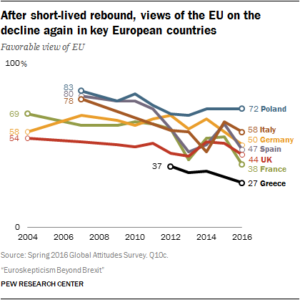
According to a Pew Research Center survey, Poles and Hungarians hold the most favorable view of the European Union. In most countries, attitudes have become more skeptical.
Immigration and the Brexit Debate
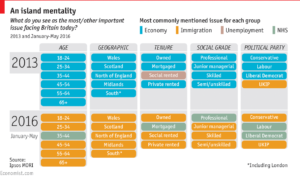
From The Economist’s Graphic detail:
Sovereign Debt in Bank Balance Sheets
In the FT, Martin Arnold reports about estimates by Fitch according to which
European banks would have to raise up to €170bn of extra capital or sell almost €500bn of sovereign debt if regulators push ahead with plans to break the “doom loop” tying lenders to their governments …
The European Commission and the European Central Bank support steps in that direction while some European governments oppose them.
Financial Transactions Tax—Stalled
In the FT, Jim Brunsden reports that the European Commission’s 2013 proposal to install a financial transactions tax has not made much progress. At least nine countries have to sign up.
The report highlights that key differences remain on how to craft exemptions from the tax, including the problem of how to shield transactions in other non-participating EU countries such as Britain. Other splits concern how to protect market-making activities by banks, and also what carveouts should apply for derivatives that are used by traders to hedge risk when they buy sovereign debt.
New Questions about Greece’s Indebtedness
On the FT’s Alphaville blog, Matthew Klein reports about discrepancies between IMF and Greek (and EU) assessments of Greek net indebtedness. The IMF appears to report lower Greek financial asset holdings than the Greek Central Bank.
Matthew Klein quotes the Greek Central Bank:
We would like to clarify that the Bank of Greece compiles its financial accounts, from which data on the general government’s net debt are derived, according to European standards. The Bank of Greece’s data are compatible with the ECB’s and Eurostat’s rules (ESA 2010) regarding financial accounts and are used as an integral part in the production of the Monetary Union’s Financial Accounts. These data can also be accessed through the ECB’s Statistical Data Warehouse at http://sdw.ecb.europa.eu/reports.do?node=1000002429.
The IMF’s series on the general government’s net debt come from its WEO database and are not necessarily based on official statistics provided by Greek Statistical authorities. We understand that they may be compiled by IMF’s desk economists (and not its Statistics Department) and we cannot vouch for their accuracy, since they are adjusted according to the programming needs of the IMF. At first glance, they appear to be based on outdated information contained in past EDP [excessive deficit procedure] documentation.