Tag Archives: United States

Dynamics of the World Income Distribution

In a Resolution Foundation report, Adam Corlett examines the “Elephant Curve.” The curve shows that between 1988 and 2008 income growth in the 70th to 95th percentile range of the world income distribution was much lower than for almost all other percentiles. Since the lower middle class of rich countries is situated around the 80th percentile of the distribution the Elephant curve has been interpreted as evidence for stagnating middle class incomes in the rich countries.

Corlett emphasizes that

  • the country composition in 1988 and 2008 is not the same. Holding it constant the Elephant curve is less pronounced.
  • “Population changes, rather than just income changes, have driven the income growth distribution in the elephant curve.” Holding the relative population size across countries constant the Elephant curve is less pronounced.
  • There is lots of variation across developed economies. “[T]he weak figures for the mature economies as a whole are driven by Japan (reflecting in part its two ‘lost decades’ of growth post-bubble, but primarily due to likely flawed data) and by Eastern European states (with large falls in incomes following the collapse of the Soviet Union after 1988). Looking only at the remaining mature economies, far from stagnation we find average real income growth of 52 per cent with strong growth across the distribution, though slightly higher at the top. [But] there are great differences between these nations. US growth of 41 per cent was notably unequally shared, with low (but not zero) growth for poorer deciles meaning that the US comes closest to matching the stagnation and inequality narrative – despite international trade being much less important on a national level there than elsewhere [my emphasis]. But most people in most other rich countries experienced stronger growth.”

The West’s Flight from Dignity

In the FT, Edward Luce worries about a loss of dignity that is reflected in contemporary politics.

Republicans generally favour liberty over equality and Democrats the reverse. Other people’s dignity is not up for grabs. Mr Trump’s hostile takeover of the Republican party has shredded that equation. … “You walked out of a Reagan rally in a spirit of optimism,” says Stuart Stevens, an adviser to Republican nominee Mitt Romney. “You leave a Trump rally ready for a fight.” …

… Luigi Zingales, recalls an event … The shocking part was not Mr Berlusconi’s boorishness but the audience’s wild applause. “Such approval would have been unimaginable before the rise of Berlusconi,” said Mr Zingales. “There is no way of measuring the degree to which he has debased public life in Italy.” The same applies to the Trump effect. But the quality of Italy’s democracy is largely an Italian affair. … What happens in America shapes the fate of democracy around the world. …

Mr Trump’s rise is bad news for our system of government on three fronts. First, he has shown you can rise to the top of the world’s most cherished democracy by scapegoating entire categories of people. … Second, he has made post-factual politics respectable. … Finally, Mr Trump has corroded faith that rules-based societies are self-sustaining.

America’s Class Distinctions

In the FT, Edward Luce writes about America’s class distinctions.

The real story, as depicted by historian Nancy Isenberg, author of White Trash, is that America was founded amid highly conscious class distinctions. African slaves were not the only group to be disenfranchised. …

It would be difficult to read America’s history — or decode the 2016 presidential election — without reference to the struggle between poor whites and the descendants of former slaves. Lyndon Baines Johnson, who became president a century after the civil war, vividly captured its political effects. “If you can convince the lowest white man he’s better than the best coloured man, he won’t notice you’re picking his pockets,” said LBJ. “Hell, give him somebody to look down on, and he’ll empty his pockets for you.”

Micro Aggression and Political Correctness

In the NZZ, Andrea Köhler qualifies the micro aggression debate on US college campuses as a “witch hunt.”

Um keine Missverständnisse aufkommen zu lassen: Der allgemeine Konsens, Diskriminierung zu ahnden, ist hier nicht gemeint. Selbstverständlich gilt es, traumatisierte Menschen zu unterstützen und Minoritäten zu schützen; letzteres hat das Attentat von Orlando einmal mehr deutlich gemacht. Doch die Hypersensibilität an den Universitäten unterminiert jede Form des intellektuellen Denkens, das per definitionem in der Auseinandersetzung mit unterschiedlichen Positionen gedeiht. Von Humor oder Ironie ganz zu schweigen.

Im Unterschied zur ersten Political-Correctness-Welle, die in den 80er und 90er Jahren den historischen und literarischen Kanon herausforderte, geht es heute nicht mehr um die Diversifizierung des Lehrplans oder das Aufbegehren gegen die Diskriminierung marginalisierter Minderheiten, sondern um das emotionale Wohlbefinden einer Generation, die als verwöhnt und übersensibel gilt. Mit diesem aus dem Ruder gelaufenen Kinderschutz wird den Studierenden eine psychische Fragilität attestiert, der der kleinste Dissens als «traumatisierend» gilt.

US Labor Market and Monetary Policy

In a blog post, Stephen Williamson argues that the US labor market is doing just fine.

Given recent productivity growth, and the prospects for employment growth, output growth is going to be low. I’ll say 1.0%-2.0%. And that’s if nothing extraordinary happens.

Though we can expect poor performance – low output and employment growth – relative to post-WWII time series for the United States, there is nothing currently in sight that represents an inefficiency that monetary policy could correct. That is, we should expect the labor market to remain tight, by conventional measures.

Science and the Senate

The Economist’s Graphic Detail reports about research documenting that

While the Senate’s interest in science is generally quite low, Senate Democrats are three times more likely than Republicans to follow science-related Twitter accounts like NASA or the National Oceanic and Atmospheric Administration. Interest in science, the authors conclude, “may now primarily be a ‘Democrat’ value”.

20160618_woc656_0

Deposit Insurance: Economics and Politics

On VoxEU, Charles Calomiris and Matthew Jaremski discuss the origins of bank liability insurance. They argue that it is redistribution, not the aim to boost efficiency, which explains a lot of the action.

… there are two theoretical approaches to explaining the creation and expansion of deposit insurance. The first is an economic approach grounded in potential efficiency gains from limiting bank runs (i.e. the public interest motivation). The second is a political approach grounded in the rising power of special interest groups that favoured insurance as a means to access subsidies (i.e. the private interest motivation).

… Because insurance reduces the incentive for market discipline, it may increase fundamental insolvency risk … whether, on balance, bank liability insurance reduces or increases risk … is an empirical question. Economic theories of liability insurance only make sense on economic grounds if the gains from liquidity risk reduction tend to exceed the moral hazard or adverse selection costs from reduced market discipline.

… Political models seek to explain why liability insurance may be chosen to favour certain groups in society even when it imposes large costs on society in the form of higher systemic risk for banks. In this context, liability insurance needs to be understood as part of an equilibrium political bargain achieved by a winning political coalition. …

… we review empirical evidence about, first, which factors are shown to be instrumental in creating bank liability insurance; and second, evidence about the consequences of passing insurance … We find that political theories are much more consistent with both sets of evidence.

… the historical push for liability insurance in the US came from a coalition of small rural bankers and landowning farmers …

Worldwide, bank liability insurance remained a unique (and controversial) policy choice of the US until the late 1950s, but it spread rapidly throughout the world in recent decades …

Like the adoption of liability insurance in the US, the recent global wave of legislation creating and expanding insurance can also be traced to political influences. …

The expansion of liability insurance has been generally associated with reductions in banking system stability …

The political theories of liability insurance point to a major political advantage. It provides an effective means for a government to supply hard-to-trace subsidies to particular classes of bank borrowers … agricultural borrowers or urban mortgage borrowers …

Liability insurance can create a subsidy for banks (which they can pass through, in part, to borrowers) only if prudential regulation and supervision permit banks to take risks at the expense of the insurer. Thus, lax regulation and supervision are an important part of the political bargain that allows liability insurance to deliver subsidies to banks and targeted borrowers. …

The Massachusetts Historical Commission And American Political Sclerosis

On his blog, John Cochrane happily reports about apparent agreement between Larry Summers and himself regarding the dangers of regulatory overkill and incompetence of government officials.

John writes:

This is a watershed. Here is the kind of reach out for middle ground that could unlock our political and economic sclerosis.  Larry is likely to be in government again sooner or later, and I hope he will push hard for this — and with more effect than the last hundred or so anti-red-tape and regulatory reform commissions.

FATCA in Reverse?

The Greens/EFA group in the European Parliament wants the European Union to exert more pressure on the United States: the US should no longer serve as a “tax haven” for European tax dodgers. Proposed measures include blacklisting and a FATCA-type 30% withholding tax on EU-sourced payments.

From the executive summary of the report commissioned by the group:

Two global transparency initiatives are underway that could help tackle financial crimes including tax evasion, money laundering and corruption: registration of beneficial ownership for companies (to identify the real persons owning or controlling such companies) and automatic exchange of bank account information between tax administrations. The European Union has made progress in both respects, with the adoption of a 4th anti-money laundering Directive (in May 2015) and by committing to implement the OECD’s common reporting standard for automatic exchange of financial account information. The United States (U.S.), in contrast, has done neither so far.

On May 5th, 2016 the U.S. announced new measures to improve its financial transparency, although not all the texts of the proposed regulations were provided. The U.S. Treasury announced three new measures: … In any case, not only would some of these new rules require Congress approval, but even the U.S. Treasury final proposals on beneficial ownership collection by financial institutions are not enough to solve all the problems nor to bring the U.S. into line with the OECD’s standard for automatic exchange of information. …

Two main issues in the U.S. affect the global progress towards transparency: … Company registration is regulated by each of the 50 states’ law. In 14 states, companies may be created identifying neither shareholders nor managers. At the federal level, tax rules require filing some information to obtain an Employer Identification Number (EIN). However, not all companies require an EIN and, even if they do, the ‘beneficial owners’ (the actual natural persons owning or controlling the company) are not necessarily among the information to be provided. Companies only have to identify one ‘responsible party’, who may be a nominee director. In order to (partially) address this, the White House 2017 budget proposal and the new measures proposed on May 5th, 2016 suggest requiring all companies (or according to the May 5th proposed rules, at least some foreign-owned disregarded entities, such as single-member limited liability companies) to obtain an EIN. Not only does this proposal need to become effective, but information would apparently still be about the ‘responsible party’ and not necessarily about the real physical person owning and controlling the company (the so-called beneficial owner).

… The U.S. has refused to join the trend for multilateral automatic exchange of information. Instead, it will implement its domestic law called the Foreign Account Tax Compliance Act (FATCA) and the related Inter-Governmental Agreements signed with other countries. However, these involve unequal exchanges of information: the U.S. receives more information than what it sends (for example, about beneficial ownership data). Oddly, though, the OECD did not include the U.S. among jurisdictions that did not commit to its new standard.

Even if the U.S. committed to exchange equal levels of information in the future, the current U.S. legal framework does not allow its financial institutions to collect beneficial ownership information for all relevant cases covered by the OECD’s global automatic exchange of information standard. U.S. financial institutions are currently only required to obtain information on beneficial owners for correspondent banking (i.e. accounts held for foreign financial institutions) and for private banking of non-U.S. clients (accounts holding more than USD 1 million).

Final rules to address these limitations have been announced on May 5th, 2016 although financial institutions must comply with them only by May 11th, 2018. However, the final rules still have the same problems that the IMF identified regarding the 2014 version of the rules so they will not fix all the problems. Remaining shortcomings include: some entities will still not be covered (i.e. insurance companies), the definition of ‘beneficial owner’ is incomplete (it does not include the ‘control through other means’ test, meaning that if you cannot identify at least one person owning 25% or more of the shares, financial institutions should try to find someone who controls the company through other means, before identifying only someone with a managerial position-who may be a nominee director), the verification of information would rely mainly on customer’s own certification, information on beneficial owners would be required for new accounts only (not for existing ones) and it will not need to be updated after the first time of collection, unless the financial institution becomes aware of changes as part of monitoring for risks. In addition, trusts will not be required to provide beneficial ownership information unless they own enough equity in an entity, such as a company, required to provide this information.

To fix this situation and promote equal levels of transparency, this paper provides a series of recommendations. For example, the European Union should consider including the U.S. in the upcoming list of tax havens, unless it effectively ensures registration of beneficial ownership information for companies and commits to equal levels of automatic exchange of information with European Union countries. Ideally, all financial centres should effectively implement the OECD standard for automatic exchange of information (by becoming a party to the OECD Amended Multilateral Tax Convention, signing the Multilateral Competent Authority Agreement and agreeing to exchange information with all other cosignatories). The European Union could thus consider imposing a sanction (such as a 30% withholding tax on all EU-sourced payments) against any financial institution that refuses to automatically exchange information about EU residents holding accounts abroad. In a second stage, sanctions could also be used to ensure that financial institutions from financial centres will also provide information to developing countries with which the European Union is already exchanging information.

Reports by René Höltschi in the NZZ as well as Markus Fruehauf und Winand von Petersdorff in the FAZ.

Inequality and the Welfare State

A new book on inequality by Branko Milanovic adopts an international perspective. The Economist reviews the book:

Like Mr Piketty, he begins with piles of data assembled over years of research. He sets the trends of different individual countries in a global context. Over the past 30 years the incomes of workers in the middle of the global income distribution—factory workers in China, say—have soared, as has pay for the richest 1% (see chart). At the same time, incomes of the working class in advanced economies have stagnated. This dynamic helped create a global middle class. It also caused global economic inequality to plateau, and perhaps even decline, for the first time since industrialisation began. …

Mr Milanovic suggests that both [Kuznets and Piketty] are mistaken. Across history, he reckons, inequality has tended to flow in cycles: Kuznets waves.

In the FT, Martin Wolf argues that a significant part of the (British) welfare state is about insurance rather than redistribution:

Evidence for this comes from another IFS study  … This examined the effects of the tax and benefit systems on people born between 1945 and 1954 …

First, income is far less unequal over lifetimes than in any given year. This is because a big proportion of inequality is temporary … Second, largely as a result, more than half of the redistribution achieved by taxes and benefits is over lifetimes rather than among different people. Third, in the course of adult life, only 7 per cent of individuals receive more in benefits than they pay in taxes, even though 36 per cent of people receive more in benefits than they pay in taxes in any given year. Finally, in-work benefits are just as good as out-of-work benefits at helping people who remain poor throughout their lives but they do less damage to incentives to work. Higher rates of income tax, meanwhile, target the “lifetime rich” relatively well because mobility at the top is relatively modest.

Marcel Fratzscher also wrote a book on the topic, focusing on Germany. He argues that the “Verteilungskampf” (redistributive struggle) intensifies and that equality of opportunity is being lost. In the FAZ, Jan Hauser summarizes a critique of the book by another Berlin based professor, Klaus Schroeder, who argues that the text is very short on substance.

Spending Inequality

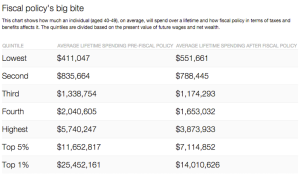
In a New Republic blog, Alan Auerbach and Larry Kotlikoff discuss lifetime spending inequality. Due to taxes and income variability over the life cycle, this is much smaller than wealth or income inequality.

3114c4f1245834a98303e801cbf1c9b8d304b13d

Auerbach and Kotlikoff write:

The top 1 percent of 40-49 year-olds face a net tax, on average, of 45 percent. … For the bottom 20 percent, the average net tax rate is negative 34.2 percent. …

Our standard means of judging whether a household is rich or poor is based on current income. But this classification can produce huge mistakes. … For example, only 68.2 percent of 40-49 year-olds who are actually in the third resource quintile using our data would be so classified based on current income.

fce80af444797972295d81da9d342c6ee1f61256

Not Guilty of Money Laundering, but Out of Business Anyway

The Economist continues to report critically on US regulatory pressure abroad and possible double standards.

The Financial Crimes Enforcement Network (FinCEN), part of America’s Treasury, [has] rescinded a devastating finding against a European bank suspected of facilitating money-laundering. The withdrawal, less than a year after the designation, looks like a climbdown. …

Some suspect the bank was a pawn in a tussle between governments: miffed that Andorra was slow to adopt American-style anti-money-laundering rules … America decided to show who was boss by selecting a bank to pick on. There is some evidence to support this sacrificial-lamb theory. … an American diplomat suggested that America chose to “use the hammer” on BPA as a way of resolving wider concerns about Andorra. …

These cases highlight two problems with FinCEN’s money-laundering cudgel. The first is double-standards. It tends to go after only small banks in strategically unimportant countries … The second is its lack of openness. It faces no requirement to make detailed evidence public, or even available to a court, at the time of action. By the time any challenge is heard, it may be too late for the bank in question.

Microsoft Buys Credibility in Germany

In the FT, Murad Ahmed and Richard Waters report about Microsoft’s strategy to regain customer trust in cloud services in light of widespread US government surveillance. According to the report, Microsoft outsources data storage to a German company. The idea is that

T-Systems will act as a “trustee” of the facilities, with Microsoft insisting its employees will have no access to the data held at the facilities without the German company’s permission. The companies believe this arrangement means Microsoft will not have to respond to governmental demands for information held in these data centres, forcing official requests to go through German authorities instead.