
On his blog, Lukas Hässig suggests that a leading Swiss banker might have exploited insider information. The comments to the post are even more revealing than the article.
Tag Archives: Switzerland
“Contemplating the End of Fractional Reserve Banking”
Presentation and Q&A session at an event organized jointly by the CFA Institute and the CFA Society Switzerland. Live webcast.
Gottardo 2016
June 1st marks the official opening of the longest railway tunnel on Earth, cutting through the Alps.
Official website. Profile of the rail track between Zurich and Lugano. Report about the contender.
Basic Income
In the FT, John Kay points out that basic income proposals have one major drawback: They are very—expensive.
Not everyone agrees. Switzerland will hold a national referendum on the introduction of an unconditional basic income on June 5th, 2016. The supporters of the proposal write:
A basic income already exists today. Everyone obtains one from somewhere; otherwise we would not be able to live. In our society today, no one can survive without an income. The level of a basic income is currently included in the existing incomes. The shift that is needed now is to make current incomes free of conditions up to the level of this basic economic security. In fact, the introduction of an unconditional basic income does not cost anything. To assure basic security by means of a social contract will bring about a new situation for income of all origins. It opens up the possibility for negotiations at all levels. Principally, the existing incomes could be decreased by the amount of the basic income.
Addendum: The Economist discusses the pros and cons of universal basic income proposals.
The Public Sector’s Portfolio Choice
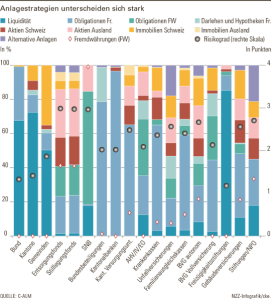
In the NZZ, Michael Schaefer reports about a study that analyzes the portfolio composition of public sector entities and social security institutions. Cantons and the Federation mostly hold cash. The SNB’s portfolio is among the riskiest.
Explicit and Implicit Subsidies for Swiss Farmers
In the NZZ,
- Direct payments: CHF 2.8 billion for 53’000 farms in 2016 (roughly CHF 50 thousand per farm).
- Tariffs and other protectionist measures: According to the OECD, the value for farmers of these measures amounts to CHF 2 billion annually, while the value for the country is negative (CHF -0.5 billion).
- Multiple tax breaks: Lower capital gains tax on land sales; no value added tax on sale of produce; lower tax on notional rental value; lower effective tax on gas consumption.
Capital Requirements for Large Swiss Banks

Brexit: Minor Costs, Unclear Benefits (Given the Political Constraints)
A report by Open Europe argues that for the UK the cost of Brexit would be minor. The benefits might be minor as well. For interest groups could make it hard to reap the potential benefits of newly gained flexibility.
… the path to prosperity outside the EU lies through: free trade and opening up to low cost competition, maintaining relatively high immigration (albeit with a different mix of skills), and pushing through deregulation and economic reforms in areas where the UK has historically been sub-par compared to international partners. … whether there is appetite for such changes in the UK is unclear.
… implications for the type of relationship the UK should seek with the EU post-Brexit. Realising the potential economic gains we’ve identified – notably via immigration and deregulation – means a relatively high degree of flexibility from the EU. The confines of a Norwegian or Swiss-style arrangement would not deliver this. As such, the best option would be for the UK to pursue a comprehensive bilateral free trade agreement, aimed at maintaining as much of the current market access as possible while also adopting a broader liberalisation agenda over the longer term.
Update: The Economist reports about other cost/benefit estimates.
Switzerland’s Free Banking Era
In a VoxEU post, Stefan Gerlach and Peter Kugler discuss the experience of Switzerland during the free banking era in the second half of the 19th century.
Swiss Government Dismisses Chicago Plan
The Federal Council dismisses the popular initiative to implement a Vollgeld regime—the “Swiss Chicago plan.” The Council argues that the proposal to abolish inside money creation runs counter to the government’s financial stability strategy and might undermine credit creation as well as trust in the Swiss Franc.
The Economist reports as well:
As the central bank issued more money, the government points out, its liabilities (cash) would rise without any increase in its assets. This, the government fears, would undermine confidence in the value of money. … There would need to be heavy-handed rules to make sure that banks did not create “money-like” instruments. … Finance, a huge part of the Swiss economy, would be turned inside-out, with unpredictable but probably expensive consequences. … The government also points out that the initiative only guards against one particular form of financial instability.
The Academic Ghostwriting Business
In the NZZ, Katharina Bracher reports about the flourishing ‘academic’ ghostwriting market in Switzerland. Firms like GWriters, Acad Write oder Acadoo offer ‘advice’ for Master and PhD theses writers. Demand is particularly high for law and business theses. A PhD thesis costs roughly CHF 25’000.
A German court has ruled that
das auftragsweise Erstellen von Hochschul-Abschlussarbeiten und Dissertationen zwar gegen die «guten Sitten» verstosse. Es handle sich aber «lediglich um ein rechtlich missbilligtes Gewerbe». Ghostwriting steht damit auf einer Stufe mit der Prostitution: zwar sittenwidrig, aber nicht verboten.
Maps
Openstreetmap, the free, detailed map of the world.
Maps of Switzerland with a time shift function.
Previous posts: Animated historical maps; maps of WWI and WWII, German relative real estate prices, European population growth, and political risk.
Drivers of High Skilled Migration into Switzerland
In the December Issue of Die Volkswirtschaft, Ronald Indergand and Andreas Beerli argue that increased high skilled migration into Switzerland mainly resulted from (i) higher educational attainment in the source countries and (ii) stronger demand by Swiss firms for high skilled labor.
The authors argue that the agreement between Switzerland and the European Union on the free mobility of labor (which is in force since 2002) did not contribute to an improved skill mix. Rather to the contrary, lower barriers to migration for EU citizens might have contributed to a slight reduction in the average skill of immigrants from the EU.
Tax Federalism
In the NZZ,

The decentralized tax system, tax competition between cantons and communities as well as mobility of high income tax payers imply that the effective average income tax rate substantially falls short of the unweighted average tax rate on high incomes. In fact, the effective average tax rate is degressive for high incomes, see the second figure (which the authors reproduce from an article by Roller and Schmidheiny (2015)).

Switzerland will Vote on “Vollgeld”
A group of Swiss citizens lobbying for monetary reform has succeeded: after collecting more than 100,000 signatures a referendum will have to be held in the next years. In the ballot, Swiss citizens will vote on no more or less than the future of the monetary system in Switzerland.
According to the group’s proposal inside-money creation by banks will eventually be prohibited. Deposit claims vis-a-vis commercial banks would be transformed into claims vis-a-vis the central bank and deposit liabilities of commercial banks would be transformed into liabilities of those banks vis-a-vis the central bank. Within a certain time span, commercial banks would have to repay those liabilities. Moreover, they would be prohibited from ever creating deposits again—that is, all money should be base money.
Here are previous blog posts on the topic: the initiative; comment; narrow banking proposals; Icelandic debate.
Update: Discussion by Alex Tabarrok in a marginal revolution post.
Money, Interest Rates, Exchange Rates and Inflation in Switzerland


Commuting into Switzerland
In the NZZ, Simon Gemperli reports about updated statistics on “Grenzgänger,” people residing outside of Switzerland but commuting into the country for work (press release by the Federal Statistical Office). About 300’000 people fall into that category. Since 2001, their number has doubled while the number of resident foreigners in Switzerland has increased by 25 percent and the total resident population has grown by 12 percent.
At the end of 2014, 8.2 million people resided in Switzerland; 2.0 million of them were non-Swiss (source).
Swiss German, Standard German, and Swiss Standard German
In the NZZ am Sonntag, Reto Hunziker argues that the schooling system in the German speaking part of Switzerland undermines students’ ability to speak proper German. Hunziker wants the Swiss to speak either their Swiss German dialect or Standard German—not the Swiss German dialect or Standard-German-As-Spoken-In-Schools-In-Switzerland.
Wikipedia article on High German languages. Wikipedia article on German dialects.
Income and Wealth Distribution in Switzerland
The website Verteilungsmonitor provides an overview.
Major IMF-Internal Disagreement Preceded the First Greek Bailout
At the 9 May 2010 meeting at which the IMF board approved the first bailout program for Greece, not all members approved. In fact, many members, including the Executive Director representing Switzerland, challenged the proposal, suggested less optimistic scenarios and asked for modifications. The Wall Street Journal published excerpts of the minutes in October 2013, see below.
Sebastian Bräuer in the NZZ am Sonntag also reports on the issue. He points out that the Swiss Executive Director asked what would happen if the Greek government were not to implement the agreed reforms; and if IMF and European commission were to disagree. Bräuer also reports that some European banks would have been prepared to bear losses resulting from their Greek exposure, see below.
The WSJ writes:
Swiss executive director Rene Weber in a prepared statement to the board for the May 9, 2010 meeting: We have “considerable doubts about the feasibility of the program…We have doubts on the growth assumptions, which seem to be overly benign. Even a small negative deviation from the baseline growth projections would make the debt level unsustainable over the longer term…Why has debt restructuring and the involvement of the private sector in the rescue package not been considered so far?”
“The exceptionally high risks of the program were recognized by staff itself, in particular in its assessment of debt sustainability.”
“Several chairs (Argentina, Brazil, India, Russia, and Switzerland) lamented that the program has a missing element: it should have included debt restructuring and Private Sector Involvement (PSI) to avoid, according to the Brazilian ED, ‘a bailout of Greece’s private sector bondholders, mainly European financial institutions.’ The Argentine ED was very critical at the program, as it seems to replicate the mistakes (i.e., unsustainable fiscal tightening) made in the run up to the Argentina’s crisis of 2001. Much to the ‘surprise’ of the other European EDs, the Swiss ED forcefully echoed the above concerns about the lack of debt restructuring in the program, and pointed to the need for resuming the discussions on a Sovereign Debt Restructuring Mechanism.”
“The Swiss ED (supported by Australia, Brazil, Iran) noted that staff had ‘silently’ changed in the paper (i.e., without a prior approval by the board) the criterion No.2 of the exceptional access policy, by extending it to cases where there is a ‘high risk of international systemic spillover effects.’”
The NZZ writes:
[Swiss ED Weber asked:] “Wie reagiert der Fonds, wenn die Behörden die Sparmassnahmen und Strukturreformen nicht umsetzen?”
[IMF-deputy John Lipsky said:] “Es gibt keinen Plan B. Es gibt einen Plan A und die Absicht, dass Plan A erfolgreich ist.”
“Ich kann die Direktoren informieren, dass deutsche Banken Unterstützung für Griechenland erwägen”, sagte der deutsche IMF-Direktor Klaus Stein. Sein französischer Kollege Ambroise Fayolle ergänzte, auch die Banken seines Landes würden ihren Job tun.
Gotthard Base Tunnel
In about a year, regular train service will start through the new, 59 km long Gotthard base tunnel. The official website with more information on the world’s longest rail tunnel.
Non-Basic Basic Income Schemes Are Expensive
The Economist reviews the history of basic income proposals and concludes that basic income schemes that actually provide meaningful safety are too expensive.
Income Taxes in Switzerland
They are higher than many people outside of Switzerland suspect. Moreover, their cantonal and municipal components vary considerably across regions. Iwan Städler’s report in the Tagesanzeiger Blog provides an interactive graphic.
The federal tax levy can be computed using this tool.
Swiss Withholding Tax Refunds Subject to Restrictions
Katharina Fontana reports in the NZZ about a decision by Switzerland’s highest court concerning the refund of withholding tax on dividends to foreign investors. According to the ruling such refunds may be denied if the investors are found to have engaged in financial engineering with the purpose to help clients circumvent the Swiss withholding tax.
Universities
The Economist featured a special report on universities. Some elements:
On the value added of university education (see this article):
Employers are not much interested in the education universities provide either. Lauren Rivera of Northwestern University’s Kellogg School of Management interviewed 120 recruiters from American law firms, management consultancies and investment banks. Their principal filter was the applicant’s university. Unless he had attended one of the top institutions, he was not even considered. “Evaluators relied so intensely on ‘school’ as a criterion of evaluation not because they believed that the content of elite curricula better prepared students for life in their firms…but because of the perceived rigour of the admissions process,” Ms Rivera wrote. After the status of the institution, recruiters looked not at students’ grades but at their extracurricular activities, preferring the team sports—lacrosse, field-hockey and rowing—favoured by well-off white men.
On rankings (see this article): More than 50 of the top 100 universities (according to the Shanghai ranking) are located in the US. Switzerland has the highest density of these institutions per capita (6.2 top universities per 10m people, next is Sweden before the Netherlands).
On public and private funding (see this article):
