
In a VoxEU column, which is based on CEPR Discussion Paper 22119, Pamfili Antipa, Anna Grodecka-Messi, Marius Hafke, Clemens Jobst, Enrique Jorge-Sotelo, Daniel Kaufmann, Eva Mulder, Kilian Rieder, and Stefano Ugolini describe how European central banks offered current accounts to non-banks until the mid-20th century.
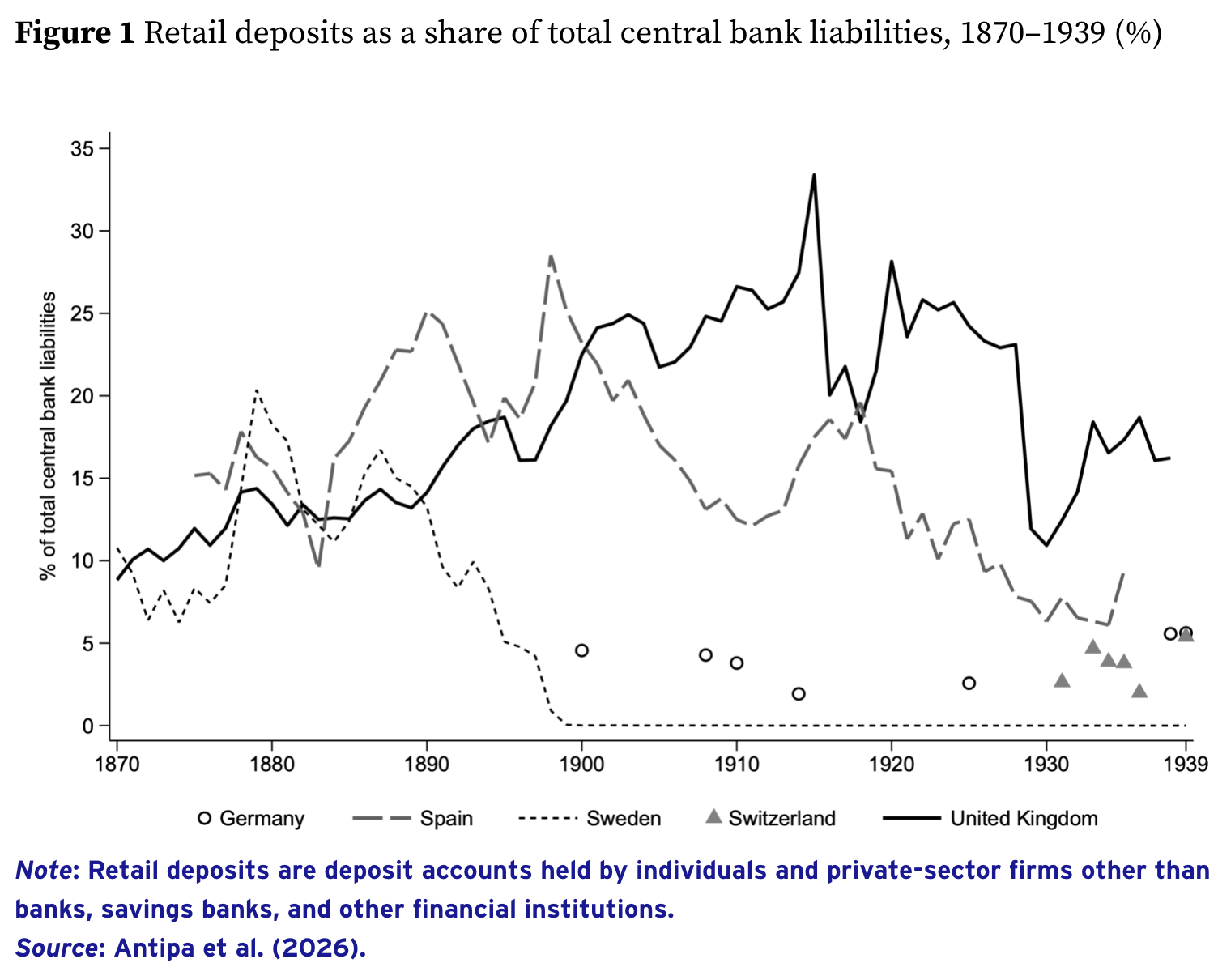
The authors conclude:
First, take-up was a design outcome. Restrictive holding limits and zero remuneration may well reproduce the modest use and narrow clientele of central bank accounts in much of Europe in the past. At the same time, the plan to prevent firms from holding digital euro balances beyond very short periods would address the disintermediation channel that mattered most in the past, when the increase in balances often came predominantly from firms (e.g. Antipa and Rieder 2026).
Second, safe-haven flows were conditional on trust in the central bank and on what an account offered relative to cash. Third, crisis inflows need not be temporary, in particular when a crisis durably damages private alternatives. Fourth, whether deposit migration harms commercial bank lending depends less on the size of the flows than on whether and how the central bank recycles them.